

How to Create a Social Media Strategy for Your Business: 9 Steps and a Template
A social media strategy for a business is a 1 to 3 page document that answers five questions: why the company is on social media, who it's talking to, on which platforms, about what and how often, and which metrics will show it's working. You can put one together in 9 steps and review it once a quarter.

A social media strategy for business exists so that your accounts stop being a pile of random posts published "because we should." Without one, a company posts whatever comes to mind, can't explain why one month went well and the next didn't, and can't say what it got for the money and time spent.
This guide shows how to create a social media strategy step by step, what the final template should look like, and how to turn the document into daily work. The running example is a small car repair shop, but the logic is the same for a salon, a bakery, a clinic or a real estate agency.
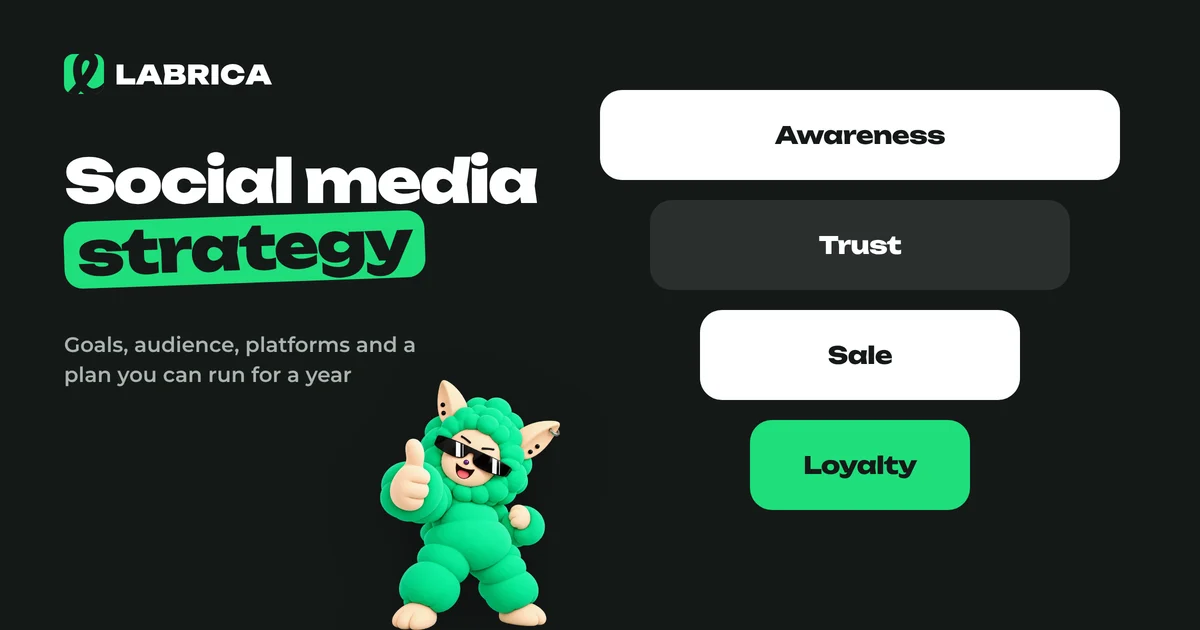
Social media strategy vs content calendar
The two are often confused, though they answer different questions.
| Social media strategy | Content calendar | |
|---|---|---|
| Question | Why and where we're going | What we publish and when |
| Horizon | A quarter, six months, a year | A week, a month |
| Contents | Goals, audience, platforms, positioning, pillars, KPIs | Dates, topics, formats, copy |
| How often it changes | Once a quarter or when business goals shift | Constantly |
| Who uses it | Owner, marketer, social media manager | Social media manager, writers, designer |
The strategy is the frame. The content calendar is how it plays out day to day. If you have a calendar but no strategy, posts exist on their own and don't lead to a business result. For the calendar side, see the social media content calendar template.
How to create a social media strategy: 9 steps
Step 1. Set a business goal
Start with the business, not with social media. What matters most right now: more inquiries, repeat sales, local awareness, hiring, launching a new product?
Then translate that into a goal for social media. A good goal is specific and verifiable:
- Bad: "Grow our social media."
- Good: "Get booking requests through Telegram and Facebook and reach a steady flow by the end of the quarter."
For a car repair shop, the business goal might be to fill weekdays, when the shop is less busy. The social media goal then becomes booking requests for weekday slots.
Step 2. Describe your audience
An audience isn't "men aged 25 to 55." Describe 2 or 3 segments through situations and motives.
- Who they are and what life situation they're in.
- What problem they're solving when they look for you.
- What worries them and what stops them from buying.
- Where they spend time on social media and what content they consume.
Example for a car repair shop:
- Owners of cars 5 to 10 years old who are afraid of being upsold. They care about transparency and explanations.
- Busy people with no time for car service. They care about online booking, turnaround time, a loaner car or a waiting area with coffee.
- Car enthusiasts who do a lot themselves. They're interested in tips and breakdowns.
Step 3. Study your competitors
Take 3 to 5 competitors and look at their social media without judging "like it or not." Write down:
- which platforms they're on and where they're actually active;
- which pillars and formats they use;
- which posts get the most reactions and comments;
- what their tone is and what they're missing.
The goal isn't to copy but to find an open niche in how you present yourself. If every repair shop in the area posts only promotions, there's room for honest "what broke and why" breakdowns. The full method is in the guide to social media competitor analysis.
Step 4. Define your positioning and voice
Answer in one sentence: why should a customer choose you? Then decide how you sound.
- Formal or casual.
- Expert, friendly, with humor.
- Which words you use and which are banned.
- Which promises you never make.
For the car repair shop: "We explain what we do and why, and show the old parts. Tone: polite, calm, no scare tactics." How to document a brand voice is covered in detail in the guide to brand voice.
Step 5. Choose your platforms
You don't need to be everywhere. Choose by two criteria: where your audience is, and which platform you have the resources to produce content for.
| Platform | When it fits | What matters |
|---|---|---|
| Telegram | Expert content, a loyal audience, announcements | Consistency, a personal tone |
| Facebook* | Local business, groups, booking through messages, older audiences | A well set-up page, services listed, clear calls to action |
| Instagram*, Threads* | Visual niches, personal brands | Visuals, carousels, short videos |
| YouTube, TikTok | Educational and entertaining video | Resources for video |
A practical guideline: one main platform and one or two secondary ones where you adapt content.
Step 6. Build your content pillars
Content pillars are recurring post types that serve your goals. Usually 4 to 6 are enough.
For the car repair shop:
- Case breakdown. What came in, what we found, what we did, how long it took.
- Owner tips. Seasonal checks, warning signs of a breakdown.
- Behind the scenes. Mechanics, equipment, the process.
- Q&A. From comments and phone calls.
- Offer. Open weekday slots, seasonal services.
- Engagement. Polls, "guess the part."
Set proportions: for example, sales posts make up no more than a quarter, and the rest is value, trust and engagement. How to build a set of pillars from scratch is covered in the guide to content pillars.
Step 7. Decide on frequency and formats
Frequency depends on your resources. Three posts a week, steadily, beat ten in the first week followed by silence.
- Main platform: 3 to 5 posts a week.
- Secondary platforms: adapted versions of the main platform's best posts.
- Formats: text, photos, carousels, short videos, in whatever mix you can sustain.
More on cadence is in the guide on how often to post on social media.
Step 8. Set KPIs and metrics
Metrics should follow from the goal in step 1. Split them into three levels:
- Reach: views, follower growth.
- Engagement: reactions, comments, saves, shares, ER.
- Business results: link clicks, inquiries, bookings, sales.
For business metrics, put UTM tags on every link in your posts, or you won't know which post brought a customer. Set targets from your own current baseline, not from someone else's numbers on the internet. See social media KPIs and UTM parameters for social media for details.
Step 9. Assign roles and set up the process
Decide who comes up with topics, who writes, who makes visuals, who approves, who publishes and who answers comments. Write down:
- post statuses: draft → in review → approved → scheduled;
- who has the right to approve;
- deadlines: how many days before publishing a post must be ready;
- how often you review analytics and revise the plan.
The guide to a content approval workflow walks through this step in detail.
Social media strategy template
Copy this table into a document and fill it in. If you can't fill a section, that's a sign you need to go back to the matching step.
| Section | What to fill in | Example: car repair shop |
|---|---|---|
| Business goal | What the business needs this quarter | Fill weekdays |
| Social media goal | A specific result from social media | Booking requests for weekday slots via Telegram and Facebook |
| Audience | 2 or 3 segments with motives and fears | Cautious owners, busy people, DIY enthusiasts |
| Positioning | Why people choose us | We explain and show, no upselling |
| Tone | Form of address, style, bans | Polite, calm, no scare tactics |
| Platforms | Main and secondary | Facebook main, Telegram for tips, Instagram for visuals |
| Pillars and shares | 4 to 6 pillars with proportions | Breakdowns 30%, tips 25%, behind the scenes 15%, Q&A 10%, offers 20% |
| Frequency | Posts per week by platform | Facebook 4, Telegram 3, Instagram 2 |
| Formats | Text, photos, carousels, video | Before-and-after photos, tip carousels, short videos from the service bay |
| KPIs | Metrics by level | Reach, ER, UTM clicks, inquiries |
| Process | Roles, statuses, deadlines | Social media manager writes, owner approves, plan a week ahead |
| Review | When and how we analyze | Metrics weekly, strategy quarterly |
The percentages in the example are internal pillar proportions you set yourself, not a standard.
Social media sales strategy: how a strategy turns into inquiries
A strategy with no path from post to purchase brings reach but not revenue. Check that it covers four links:
- Where a person first sees you. Ads, recommendations, search, shares. Useful posts and short videos work here.
- Why they'll trust you. Reviews, process, people, results. These are your trust pillars.
- How they take a step. A booking button, messages, a link to your website, a bot. There should be one clear step.
- What happens after they reach out. Who replies, how fast, following what script. Social media easily loses inquiries if messages are read once a day.
A strategy usually has fewer sales posts than other types. They work once the feed has already convinced the person. The structure of these posts is covered in the guide on how to write a sales post.
How to turn the strategy into daily work
The most common problem is a nice document nobody opens. To keep the strategy alive:
- Move the pillars into your content calendar. Each week gets a set mix of pillars.
- Make templates. For each pillar, a post structure and a visual template.
- Work in batches. Once a week, prepare posts for the following week.
- Schedule posts in advance. Auto-posting removes the dependence on someone remembering to hit "publish."
- Check the numbers once a week and write down conclusions: what worked, what to repeat, what to drop.
In LABRICA, this chain lives in one place. The brand scan studies the company's website and social accounts and builds a brand profile (audience, products, tone and rules), which covers a good part of steps 2 and 4. LABI AI suggests ideas and writes posts in the company's voice for the goal you choose. The content calendar with auto-publishing covers step 7, roles and approval statuses cover step 9, and analytics plus short links with UTM tags cover step 8. Competitor analysis helps with step 3.
If a contractor or agency will execute the strategy, turn it into a social media brief. The bridge between strategy and calendar is a content matrix: it maps topics to audience segments and stages of the purchase.
Common social media strategy mistakes
- The goal is "to be on social media." Without a measurable goal, there's no way to tell if the strategy works.
- The audience is "everyone." Posts for everyone hook no one.
- Many platforms, no resources. Five abandoned accounts are worse than one active one.
- Sales only. A feed of nothing but promotions loses attention fast.
- No approval process. Posts get stuck or go out with mistakes.
- The strategy is never reviewed. The market, the product and the audience change, and the document has to change with them.
How to tell if your strategy is working
Four to six weeks after launch, compare your metrics with the starting point. Look at the trend, not the absolute numbers.
- Are reach and engagement growing on your main platform?
- Which pillars bring more reactions and clicks, and which are sagging?
- Are inquiries coming from the UTM links in your posts?
- Are you keeping to the planned frequency?
If the metrics aren't moving, check in order: does the content fit the audience, is posting consistent enough, do posts have a clear call to action. Which metrics to watch is covered in the guide to social media analytics.
The basics, team roles and what a social media manager does are explained in what is social media marketing.
*Instagram, Facebook and Threads belong to Meta Platforms Inc., which is designated an extremist organization in the Russian Federation.
Frequently asked questions
How long does it take to create a social media strategy?
For a small business, a basic strategy can be put together in one or two working days if the owner takes part in the steps on goals and audience. Competitor analysis usually takes the longest.
How often should you review your social media strategy?
About once a quarter, and also when you launch a new product or your audience or business goals change. The content calendar, meanwhile, is adjusted weekly.
Does a small business need a social media strategy?
Yes, in a short form. The one-page template table from this guide is enough. It protects you from chaotic posting and helps you see what works. See also the guide to social media for small business.
Can AI create a social media strategy?
AI helps with a draft: audience segments, pillars, ideas. But business goals, positioning and platform choice are better decided by you, and AI output should be checked.
How does LABRICA help with a social media strategy?
LABRICA builds a brand profile through a brand scan, generates posts in that voice, and runs a content calendar with auto-publishing, team approvals and analytics with UTM links. The strategy itself, the goals and the priorities are yours to set. You can try it free.
Run your social media with LABRICA
Ideas, posts in your brand voice, images, a content calendar and auto-publishing to every network in one window. No card required to start.
- Brand scan of your site and accounts
- Posts and carousels in your brand voice
- Auto-posting to Instagram*, TikTok, X and more
- Analytics and UTM links

Keep reading
 Strategy
What Is Social Media Marketing (SMM)? What a Social Media Manager Does and How to Get Started
Social media marketing (SMM) is promoting a business through social networks and messaging apps. A social media manager owns the whole cycle, from strategy and the content calendar to posts, community replies, ads and reporting. The main goal of SMM is leads, sales and brand awareness, and follower count matters far less.
 Strategy
Social Media for Small Business: A 2 to 4 Hours a Week Plan with Post Examples
A small business can run social media in 2 to 4 hours a week if it works by a system. Choose one or two platforms, set up three content pillars, write a week of posts in one sitting and schedule them for auto-publishing. Once a month, check which posts brought customers and repeat what works.
 Strategy
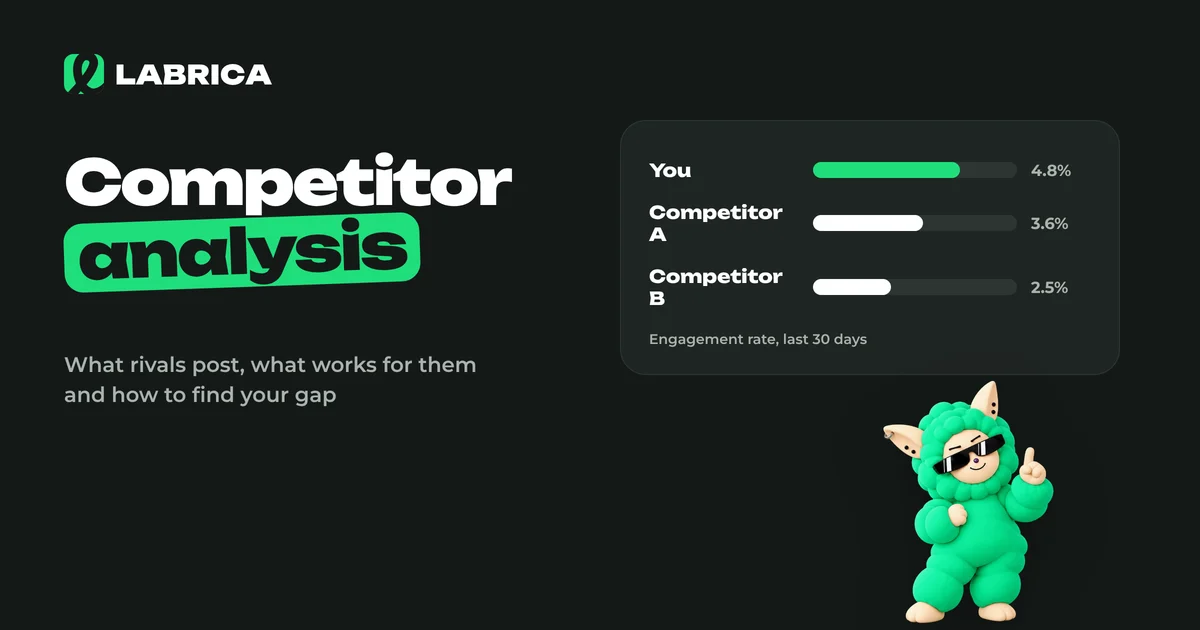
Social Media Competitor Analysis: A Step-by-Step Guide With a Template
A social media competitor analysis reviews 3 to 10 accounts in your niche using one framework: platforms, posting frequency, content pillars, formats, tone, engagement and offers. The goal is to find what already works with your audience and the gaps nobody is filling, and copying is not the point. The result is a list of ideas and hypotheses for your content calendar.