

What Is Social Media Marketing (SMM)? What a Social Media Manager Does and How to Get Started
Social media marketing (SMM) is promoting a business through social networks and messaging apps. A social media manager owns the whole cycle, from strategy and the content calendar to posts, community replies, ads and reporting. The main goal of SMM is leads, sales and brand awareness, and follower count matters far less.

SMM stands for social media marketing. In practice, the term covers everything a company does on social networks for business reasons: running an Instagram* account or a Telegram channel, publishing posts and videos, replying to people, running ads and giveaways, and figuring out which of it actually brought in customers.
The confusion starts when social media marketing gets reduced to "posting on our page." Posts are only the visible part. Underneath them sit an understanding of the audience, a plan, a visual style, comment management, advertising and the numbers that show whether any of it pays off.
What is social media marketing in plain terms
Picture a coffee shop next to a subway station. Its Instagram account shows new desserts, its Telegram channel tells people each morning which pastries are already out of the oven, and in Stories the barista explains why today's beans come from Ethiopia. People follow, drop by more often and bring friends. That's social media marketing: social networks working as a shop window, a communication channel and a sales source at the same time.
SMM has three clear goals:
- Awareness. People know the company and remember it when the need comes up.
- Trust. Reviews, behind-the-scenes, the people behind the brand. Buyers "check out" a company on social media before they buy.
- Sales and leads. Website visits, messages, bookings, orders.
Good social media marketing is always tied to one of these goals. If a post serves none of them, you can skip it.
SMM meaning: how it differs from SMO and paid social
A few other terms keep coming up next to SMM. Here's how they relate:
| Term | What it means | Example |
|---|---|---|
| SMM | All marketing on social media: content, community, ads, analytics | Running a beauty salon's accounts with ads and monthly reports |
| SMO | Optimizing the profiles themselves: bio, description, buttons, links | Profile header, highlights, pinned post |
| Paid social (targeted ads) | Paid ads inside a social network, targeted by interests and demographics | Promoting a new menu to people who live nearby with Meta ads |
| Content marketing | Useful materials that attract customers | Articles, guides, video tutorials, including on social media |
| Community management | Working with people in comments and chats | Answering questions, moderating, sparking discussion |
In small companies one person does all of this, so the "social media person" usually handles SMO, content and part of the advertising too.
What does a social media manager do
A social media manager's responsibilities depend on the company, but the core set is nearly the same everywhere.
- Learns the business and the audience. Who buys, why, and what holds them back. Without this, posts go out into the void.
- Builds the strategy and content pillars. Which platforms to be on, what to talk about, how often to post. Planning is covered in detail in social media strategy for business.
- Runs the content calendar. Plans topics and formats a month ahead, so nobody is inventing a post an hour before it goes live.
- Creates content. Copy, images, carousels, short videos. In larger teams a copywriter, designer and videographer do this, and the social media manager sets the tasks and pulls the result together.
- Publishes and keeps the schedule. Manually or with an auto-posting tool.
- Talks to the audience. Replies to comments and messages, defuses negativity, picks up on good conversations.
- Runs ads or briefs a paid social specialist.
- Measures results. Reach, engagement, clicks, leads. Prepares a report and adjusts the plan based on it.
One part of the job rarely gets mentioned: approvals. A post goes through a manager, a lawyer or a client, and without a clear process half the time disappears into back-and-forth messages. How to organize this is covered in the guide to a content approval workflow.
Social media manager, specialist and marketer: is there a difference
Job listings often use these titles interchangeably. If you do separate them, it looks like this:
- Social media specialist is the hands-on role: creates content, publishes, replies to people.
- Social media manager owns the accounts as a whole: plan, team, contractors, results.
- Social media marketer looks beyond social networks: how social works together with the website, ads, email and sales.
For a business, the title matters less than who is responsible for the numbers. If nobody is, social media quickly turns into a chore of "posting something."
Social media manager skills
The skill set has four parts.
Writing. The ability to write short and to the point, hold the brand voice and open with a strong first line. More on this in how to write a sales post.
Visuals. A sense of style, basic work with graphics and video, and an understanding of formats: carousels, vertical video, covers.
Analytics. Knowing what engagement rate, reach and CTR are, adding UTM parameters to links and drawing conclusions instead of just collecting numbers. A good place to start is what engagement rate is and how to calculate it.
Platforms. How Instagram, Telegram, TikTok, YouTube and Facebook* work, along with their rules and formats. Plus the basics of ad disclosure and handling personal data in your market.
By 2026 one more skill has joined the list: working with AI. AI already writes drafts, suggests ideas and makes images and videos. The people who stand out can set a clear task, check the result and bring it up to the brand's standard. This is covered in detail in AI for social media marketing.
How social media promotion works, step by step
If a company is starting social media marketing from scratch, the order of steps looks like this:
- Set a goal. Leads, sales, bookings, awareness. The goal shapes everything else.
- Describe the audience. Who these people are, what questions and objections they have.
- Choose platforms. Start with one or two where your customers definitely are. For a local business that's often Instagram and Facebook, for a B2B company it might be LinkedIn and YouTube, for a community-driven brand a Telegram channel.
- Set up the profile. Name, bio, cover, contact details, pinned post. See the guide to a social media bio.
- Define content pillars and a content calendar for at least a month.
- Start posting regularly. A steady 3 to 4 posts a week usually does more than ten posts in one week followed by a month of silence.
- Add ads once there's enough content that new people have something to look at.
- Review the numbers once a month and change what isn't working.
A detailed walkthrough for a small company is in social media for small business.
How to tell if social media marketing is working
Followers are a poor main metric. You can gain them with a giveaway and still have no sales. Look at a chain of metrics instead:
| What to track | What it shows |
|---|---|
| Post reach | How many people see the content at all |
| Engagement rate (ER) | How interesting the content is to the people who see it |
| Link clicks | Whether posts move people further: to the website, a booking page, a store |
| Messages and leads | Whether interest turns into inquiries |
| Sales tagged "from social media" | Whether money comes out the other end |
The most honest way to count clicks is with links that carry UTM parameters: that way Google Analytics 4 shows which post brought a person in. If sales happen through direct messages, agree with the sales team to ask "how did you hear about us" and write down the answer. For a fuller list of metrics, see social media KPIs.
How much social media marketing costs and can you do it yourself
The cost depends on who runs the accounts (an in-house specialist, a freelancer or an agency) and how many platforms are involved. Average market figures aren't worth quoting here, because they vary a lot by city and niche.
Running social media yourself is entirely possible, especially for a small business. The hard part isn't writing a post. It's doing it regularly while also serving customers. Tools that take over the routine help here.
For example, in LABRICA a brand scan studies the company's website and social accounts and builds a profile: audience, products, tone. LABRICA then suggests ideas, writes posts in that voice and generates images and videos, while the content calendar publishes everything on schedule to Instagram, Telegram, TikTok, YouTube and other connected networks. The owner only needs to review and approve. For a team of several people there are roles and approval statuses.
How to start social media marketing from scratch
If you want to learn social media marketing rather than hire someone, practice on a real project helps most. Take a business you know, or your own, set up an account and walk it through all the steps from the section above. After a month it'll be clear what works and what needs improving.
A minimum list of what to learn first:
- writing posts for a specific goal, not just to fill the feed;
- building a content calendar for a month;
- setting up an Instagram profile and a Telegram channel;
- calculating engagement rate and adding UTM parameters;
- understanding ad disclosure rules on the platforms you use;
- giving tasks to AI tools and checking their answers.
Ready-made templates for getting started are in content pillars and social media post ideas for business.
*Instagram, Facebook and Threads belong to Meta Platforms Inc., which is designated an extremist organization in the Russian Federation.
Frequently asked questions
What is social media marketing in simple terms?
It's promoting a business on social networks and messaging apps: publishing content, talking to the audience, running ads and analyzing results. The goal is awareness, trust and sales.
What does SMM stand for?
SMM stands for social media marketing, meaning marketing on social networks. The person who does it is usually called a social media manager.
What does a social media manager do?
They build the strategy and the content calendar, create or commission content, publish it, talk to the audience, run ads and report on the numbers: reach, engagement, clicks and leads.
Does a small business need a social media manager?
Not always. A small company can run one or two platforms on its own if it sets aside the time and builds a routine. A specialist makes sense when there are many platforms, ads are involved or the owner simply has no time.
Can LABRICA replace a social media manager?
LABRICA takes over the routine: ideas, draft copy, images, videos, the publishing schedule and collecting stats. Strategy decisions, fact-checking and real conversations with customers still need a person.
How many posts a week should a business publish?
A reasonable starting point for most businesses is 3 to 4 posts a week on the main platform. Consistency and usefulness matter more than volume. More in how often to post on social media.
Run your social media with LABRICA
Ideas, posts in your brand voice, images, a content calendar and auto-publishing to every network in one window. No card required to start.
- Brand scan of your site and accounts
- Posts and carousels in your brand voice
- Auto-posting to Instagram*, TikTok, X and more
- Analytics and UTM links

Keep reading
 Strategy
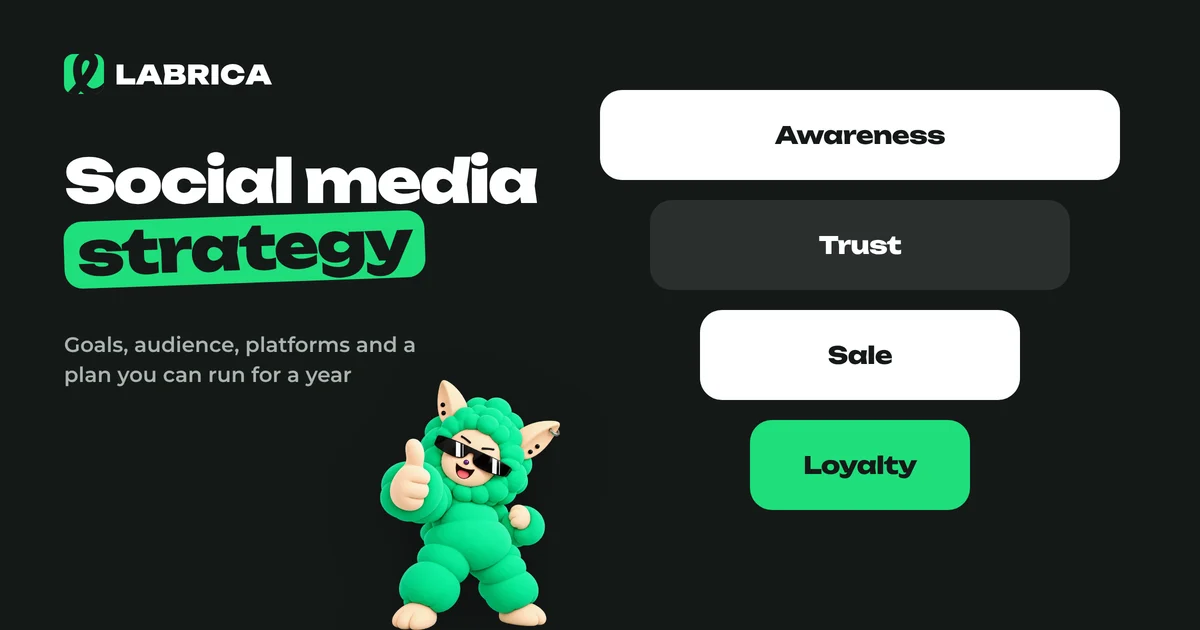
How to Create a Social Media Strategy for Your Business: 9 Steps and a Template
A social media strategy for a business is a 1 to 3 page document that answers five questions: why the company is on social media, who it's talking to, on which platforms, about what and how often, and which metrics will show it's working. You can put one together in 9 steps and review it once a quarter.
 Strategy
Social Media for Small Business: A 2 to 4 Hours a Week Plan with Post Examples
A small business can run social media in 2 to 4 hours a week if it works by a system. Choose one or two platforms, set up three content pillars, write a week of posts in one sitting and schedule them for auto-publishing. Once a month, check which posts brought customers and repeat what works.
 Content creation
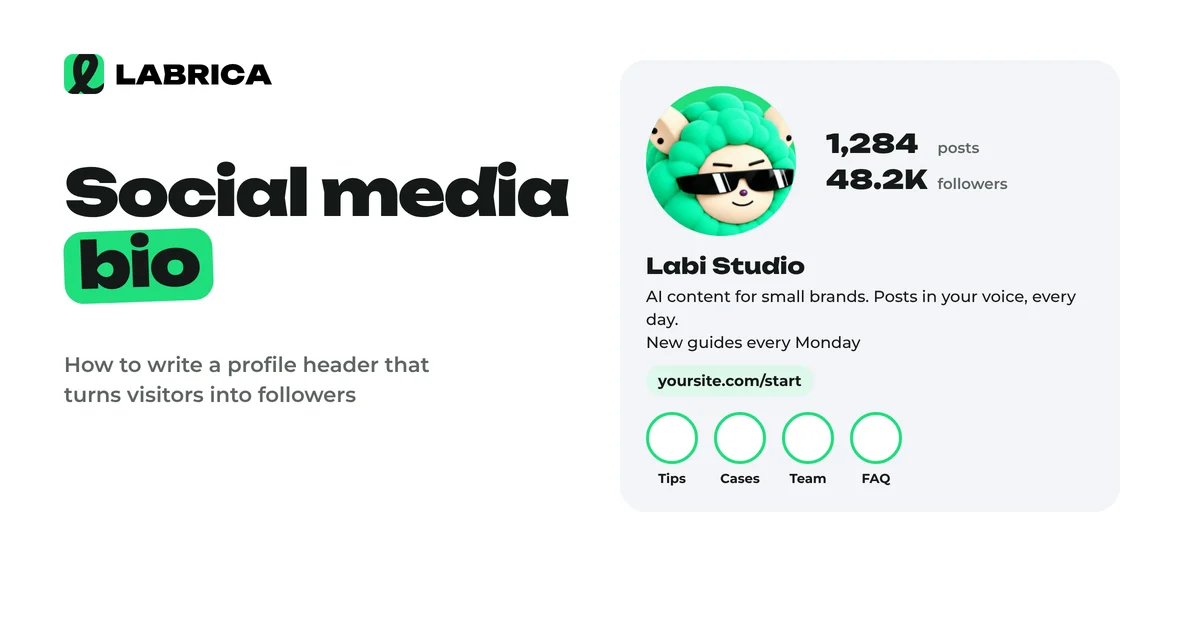
How to Write a Social Media Bio: Formula, Profile Setup Tips and 30 Bio Examples for Business
A social media bio has a few seconds to answer three questions for a new visitor. Who you are, how you help them specifically and what to do next. A reliable bio formula is what you do and for whom, then a differentiator or proof, then a call to action with a link or contact. Add a keyword people search for to your profile name.