

AI for Social Media Marketing: How It Changes the Work of Marketers, Teams and Agencies
AI for social media marketing helps at every stage of the work, from audience and competitor research to copy, visuals, scheduling and reports. It takes routine tasks off the social media manager's plate, which leaves more time for strategy, client communication and the real-life content that AI can't produce.

Most conversations about AI for social media marketing end up being about generating posts. Look at an actual day of a social media manager, though, and writing takes only part of it. The rest goes to research, planning, client approvals, publishing, replies, reports and switching between accounts.
AI in social media marketing pays off most when you apply it to the whole cycle instead of one step. This guide walks through that cycle stage by stage, looks at how roles change in a team or agency, and ends with a one-month rollout plan.
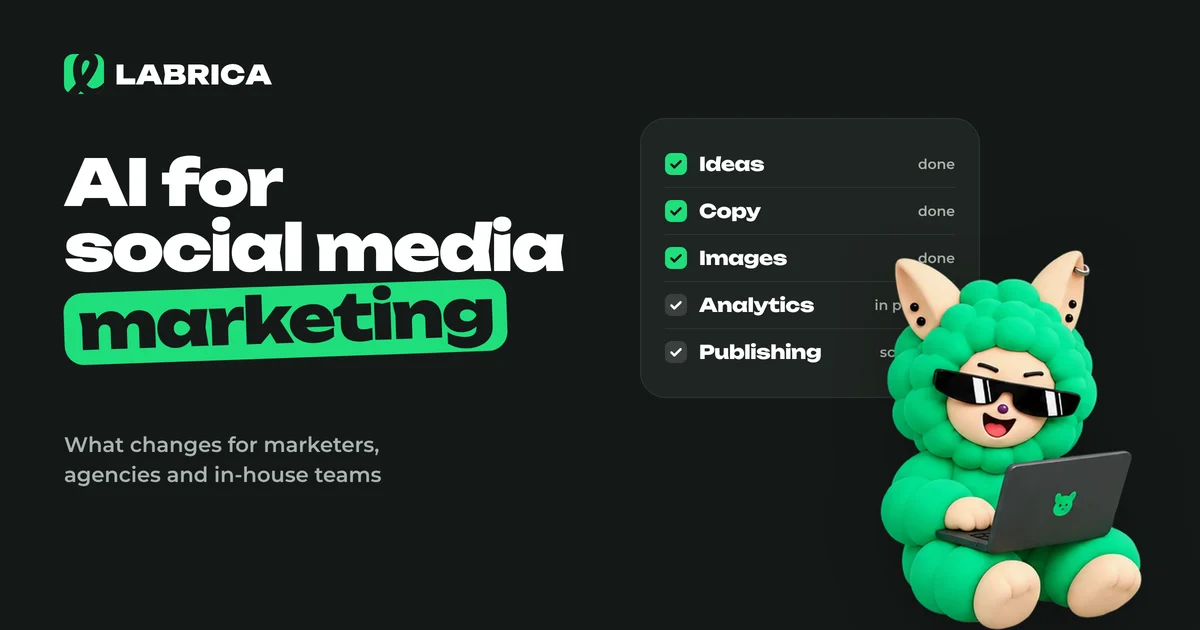
Where AI helps in the social media marketing cycle
Take a standard workflow for one account and look at what AI adds at each stage.
| Stage | What AI does | What the marketer gains |
|---|---|---|
| Getting to know the brand | Builds a profile from the website and social accounts: audience, products, tone | A fast start with a new client |
| Competitor analysis | Reviews their social accounts, topics and formats | You see what's taken and where there's room |
| Strategy and content pillars | Suggests pillars and ideas tied to goals | A draft that only needs refining |
| Content | Copy, images, carousels and video in the brand voice | A batch of posts instead of a daily scramble |
| Approvals | Statuses and roles instead of long message threads | Fewer lost edits |
| Publishing | Scheduled auto-publishing to several networks | No manual copy and paste |
| Analytics and reporting | Collects metrics, finds best posts, drafts takeaways | Client reports come together faster |
The key stages in more detail.
Getting to know the brand and the audience
Every new client starts with a brief, a look at the website, old posts and comments. AI speeds this up a lot. You can ask it to pull typical customer pain points out of reviews, spell out what makes the product different, or describe the tone based on existing posts.
Prompt: Here are 20 customer reviews of a fitness club. Pull out the recurring reasons people joined and the recurring worries they had before buying a membership. Phrase them the way customers do, not in marketing language.
In LABRICA, this stage is covered by the brand scan. From the company name and website, the platform studies the site and recent social posts and builds a brand profile that every later task relies on.
Competitor analysis
AI helps you quickly see what competitors post about, which formats work for them and where you have a chance to stand out. The goal is to find open topics and a distinct tone, not to copy anyone.
Content
This is where AI gives the most visible gain and also carries the most risk. Results are good when the AI has a brand profile and the marketer has a clear process: idea, draft, edit, fact check, visuals, approval.
Analytics and reports
AI can turn a spreadsheet of metrics into conclusions: which pillars are growing, which are slipping, what to suggest to the client next month. Check its interpretation, though. The AI sees numbers. You know the context, like a promotion, a holiday or a platform outage.
Prompts for everyday social media tasks
Here is a short prompt library for daily work. Swap in your client's details.
Content pillars for a new client:
You are a social media strategist. The client is a real estate agency that works with buyers of resale homes in one neighborhood. Goals: trust and consultation requests. Suggest 5 content pillars. For each, give the goal, format, frequency and three example topics.
A monthly content calendar:
Based on the pillars above, build a 4-week content calendar: 4 posts per week, alternate formats (text, carousel, short video), and keep in mind the client is holding an open house in week three.
An engagement post:
Come up with an interactive post for a bakery's Instagram* and Facebook* pages: a game or poll where followers pick the filling for a new seasonal pie. Write the post text and the rules.
A reply to a negative comment (a draft for review):
A car repair shop customer writes in the comments that the repair took longer than promised. Write a calm reply without excuses: acknowledge the problem and offer to continue in direct messages. Skip the template apologies.
Takeaways for a report:
Here are a beauty salon's monthly metrics by content pillar: [data]. Write three takeaways and three recommendations for next month in plain language for the business owner.
More templates are in the guide to ChatGPT prompts for social media.
How to brief AI: a formula for a good prompt
The gap between a weak result and a strong one almost always comes down to how the task is set. A simple six-part formula is worth keeping in mind.
- Role. Who the AI should be: a strategist, copywriter, editor or analyst.
- Brand context. Audience, product, differentiators, tone. If the brand profile lives in your tool, this part is filled in automatically.
- Task. What exactly you need: ideas, a post, a carousel, a script, a reply, takeaways.
- Goal. Reach, engagement, clicks or sign-ups. The structure of the copy depends on it.
- Constraints. Length, platform, banned words, facts that must appear.
- Output format. A list, a table, several options, text split into slides.
Compare two prompts for the same beauty salon.
Weak: "Write a post about manicures."
Strong: "You are the copywriter for a neighborhood salon. Clients are working women who value punctual stylists. Write a Telegram post explaining why we ask people to arrive five minutes before their appointment. The goal is fewer late arrivals without sounding reproachful. Polite and friendly, under 500 characters, two options for the first line."
The second prompt takes thirty seconds longer to write and saves several rounds of edits. If some phrasing repeats in every task, move it into a template or the brand profile.
How AI changes roles on a social media team
AI doesn't remove people from social media marketing, but it noticeably shifts who does what.
- Social media managers write less from scratch and spend more time editing, choosing, checking and thinking about strategy. Their value moves from "I write fast" to "I understand the client's business and know how to brief AI."
- Copywriters become editors of the brand voice. They polish the strongest posts, write what needs first-hand experience and train the AI with examples.
- Designers own the visual system and complex layouts, while routine illustrations and slides are generated.
- Managers or clients approve more content in less time when the process runs on statuses instead of chat threads.
For small businesses, this means running social media becomes realistic without a dedicated staff.
How is AI changing social media marketing strategy?
AI made content cheap, so strategy shifts from "how much should we post" to "what can only we say." Posts that AI writes the same way for every business stop standing out. The winners are brands with their own facts, people, data and point of view.
At the strategy level, five things change.
| Before | Now | What it means for the plan |
|---|---|---|
| The main resource is production time | The main resource is knowledge about the business and customers | Collect facts, stories and customer questions first, then generate |
| One version of a post, edits based on taste | Several versions and testing | Build tests into the plan: two angles on one topic, comparing first lines |
| A plan based on gut feel and "best times" from the internet | A plan based on your own data | Look at which topics, formats and hours work for your accounts |
| One or two networks because there aren't enough hands | Several platforms by default | Decide based on where your audience is, adapt posts instead of copying them |
| The brand voice lives in the writer's head | The brand voice is a documented asset | Write down tone, banned phrases and examples so people and AI can both use them |
Trust also matters more. With so much generated content around, followers value real details: behind the scenes, faces, actual numbers. That's no reason to drop AI. It's a reason to keep experience-based content in human hands.
One more change is easy to miss: part of your audience now finds answers through AI search instead of the feed. Expert posts and articles with concrete answers start working as sources that assistants cite. So a strategy should include useful material that answers real customer questions, alongside entertaining and sales content. The guide to generative engine optimization explains how to get cited by ChatGPT, Perplexity and Google AI Overviews.
If you want to hand AI part of the operational work too (the calendar, publishing, reports), see how AI agents for social media work and where they still need a person.
AI in a social media agency
Agencies have their own challenges: many clients, different voices, tight deadlines and constant approvals.
What to watch when bringing AI into an agency:
- A separate brand profile for every client. Otherwise one client's tone leaks into another client's posts.
- Roles and access. Who creates, who approves, who connects social accounts, who can change company details.
- Clear statuses. Draft, in review, approved, scheduled. The client sees where their content stands without a call.
- Reporting. Metrics by platform and clicks on links with UTM tags, so you can show the client actions, not just reach.
- Shared quality standards. One post review checklist for the whole team.
LABRICA handles all of this in one interface: roles with separate rights for creating, approving, scheduling and connecting social accounts, post statuses, analytics by platform, and short links with UTM tags. Team size depends on the plan; see LABRICA pricing.
Which AI tool to choose: a general assistant, separate generators or a platform
When people search for "AI tools for social media managers," they usually mean one of three setups, and each has a cost.
| Option | What you get | Weak spot |
|---|---|---|
| A general chat assistant | Quick drafts, ideas, rewrites | You explain the brand every time and publish by hand |
| A set of separate generators | Copy in one tool, images in another, video in a third | Inconsistent style, several subscriptions, manual transfers |
| A social media platform with AI | Brand profile, copy, visuals, calendar and publishing in one place | You need to set up the brand profile once |
If you run one account and post rarely, an assistant is enough. If you have several platforms and need posts every week, a platform makes more sense: it remembers the brand and puts each post straight into the calendar. That's how LABRICA works. Its post generator writes in the company's voice based on its profile, the AI image generator keeps the feed's style, and the AI content calendar spreads posts across dates. A step-by-step weekly routine is in the guide on how to use AI for social media.
Risks of AI in social media marketing and how to reduce them
| Risk | How it shows up | What to do |
|---|---|---|
| Generic copy | Posts look like thousands of others | A brand profile, a specific reason to post, real details |
| Factual errors | Wrong prices, dates, addresses | A mandatory human fact check |
| A blurry voice | Tone drifts from post to post | Written tone rules and banned phrases |
| Repetitive visuals | Images that look like everyone else's | A documented feed style, real photos |
| Blind trust in AI analytics | Conclusions that ignore context | Compare conclusions with what actually happened in the business |
| The team losing skills | People stop thinking for themselves | AI prepares options, a person decides |
A 30-day plan for using AI for social media marketing
Don't try to switch everything over in a day. This sequence works for freelancers and small teams alike.
- Week 1. Foundation. Build brand profiles for your accounts, write down tone, banned phrases and content pillars. Pick one account for a pilot.
- Week 2. Content. Prepare a week's batch of posts for the pilot account with AI. Time how long it took and note which edits you had to make.
- Week 3. Process. Set up status-based approvals and auto-publishing. Remove manual copying between tools.
- Week 4. Analytics. Compare the pilot posts with earlier ones, draw conclusions and decide which accounts to scale the approach to.
After the pilot, you'll have your own experience and clear takeaways instead of a vague opinion about whether AI works.
Checklist: are you ready for AI in social media marketing?
- Every brand has a profile: audience, products, tone, banned phrases.
- Every content pillar has a goal and a clear format.
- There's a rule for who checks facts before publishing.
- There's an approval process without endless messaging.
- Posts go out on a schedule.
- Links are tagged with UTM parameters and clicks are tracked.
- Once a month, analytics takeaways turn into changes to the plan.
*Instagram, Facebook and Threads belong to Meta Platforms Inc., which is designated an extremist organization in the Russian Federation.
Frequently asked questions
Will AI replace social media managers?
No, but it will change the job. AI takes over the routine (drafts, visuals, scheduling, collecting metrics), while strategy, review, client communication and real-life content stay with the person.
What AI tools does a social media manager need?
At minimum, three kinds of capabilities: copy generation, visual generation, and scheduling with analytics. You can assemble them from separate tools or use a platform that combines them.
Can an agency with many clients use AI for social media marketing?
Yes, as long as each client has its own brand profile and the team has roles and approval statuses set up. Without that, client voices blend together and edits get lost.
How does LABRICA help a social media team?
LABRICA builds a brand profile with a brand scan, generates posts, images, carousels and video in the company's voice, and keeps a content calendar with auto-publishing. It also offers roles and approval statuses, analytics, UTM links and competitor analysis. You can try it free.
Where should you start with AI in social media marketing?
With one pilot account and a brand profile for it. After a month of work, you'll see where AI saves time and where the process needs adjusting.
Run your social media with LABRICA
Ideas, posts in your brand voice, images, a content calendar and auto-publishing to every network in one window. No card required to start.
- Brand scan of your site and accounts
- Posts and carousels in your brand voice
- Auto-posting to Instagram*, TikTok, X and more
- Analytics and UTM links

Keep reading
 AI for social media
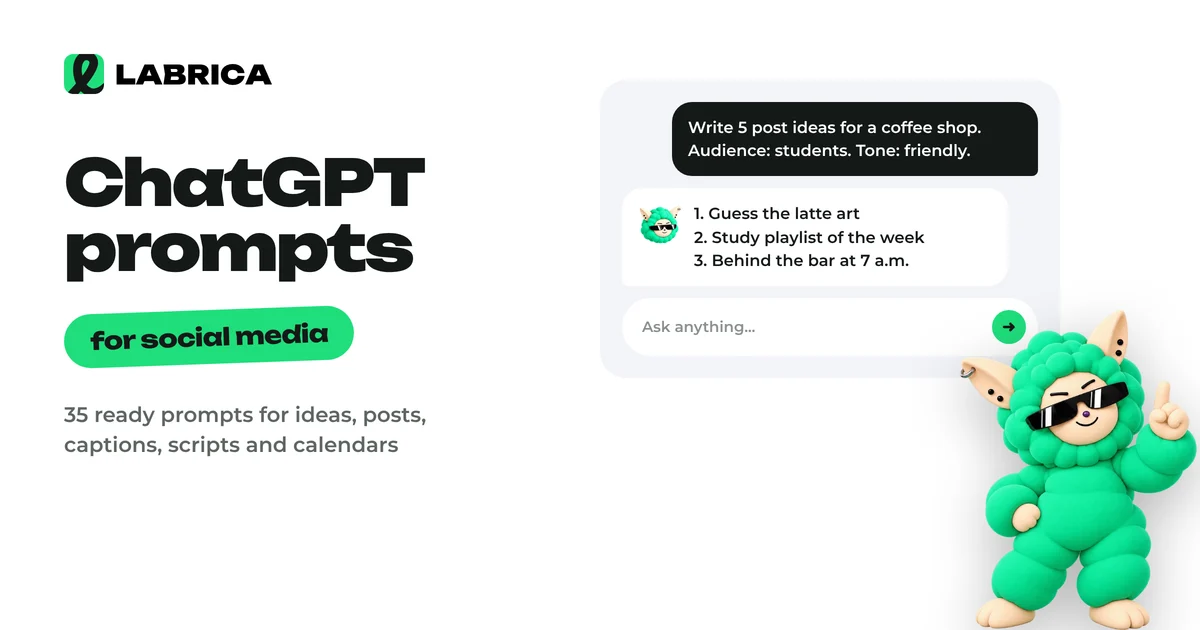
ChatGPT Prompts for Social Media: 35 Ready-to-Use Prompts by Task
A good ChatGPT prompt for social media has five parts, which are role, brand context, task, format and constraints. Below are 35 ready-to-use prompts grouped by task, with placeholders in square brackets. Fill in your business details and you get a draft that needs editing instead of a full rewrite.
 AI for social media
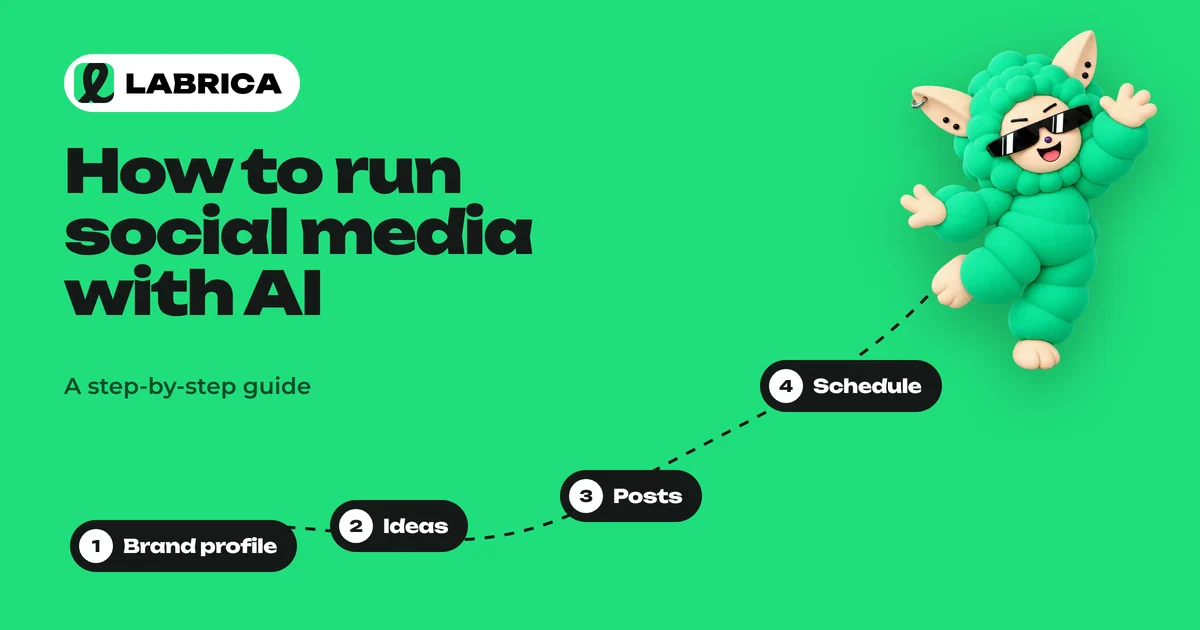
How to Use AI for Social Media: A Step-by-Step Guide for Businesses
Using AI for social media means handing the groundwork (ideas, copy, images, scheduling) to AI while you keep strategy, fact checking and the final call. It only works if the AI has a detailed profile of your brand. Without one, it writes average posts that could belong to anyone.
 AI for social media
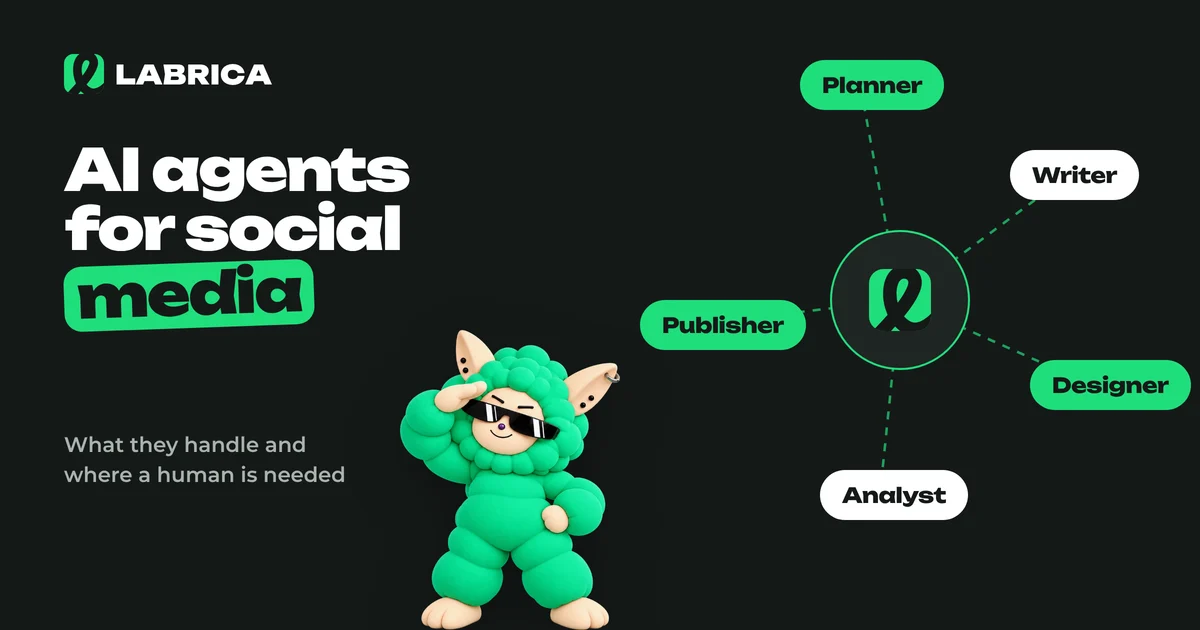
AI Agents for Social Media: What They Handle on Their Own, Where a Human Is Needed, and How to Build a Virtual Content Team
An AI agent for social media is a system that works through a chain of steps on its own, following rules you set: it analyzes your accounts, proposes a plan, writes drafts, prepares visuals, schedules posts and reports on results. It handles repetitive work well. Business facts, approvals, replies to customers and crisis situations should stay with a human.