

Content Pillars: How to Build Them in 6 Steps, Plus 24 Content Pillar Examples by Goal
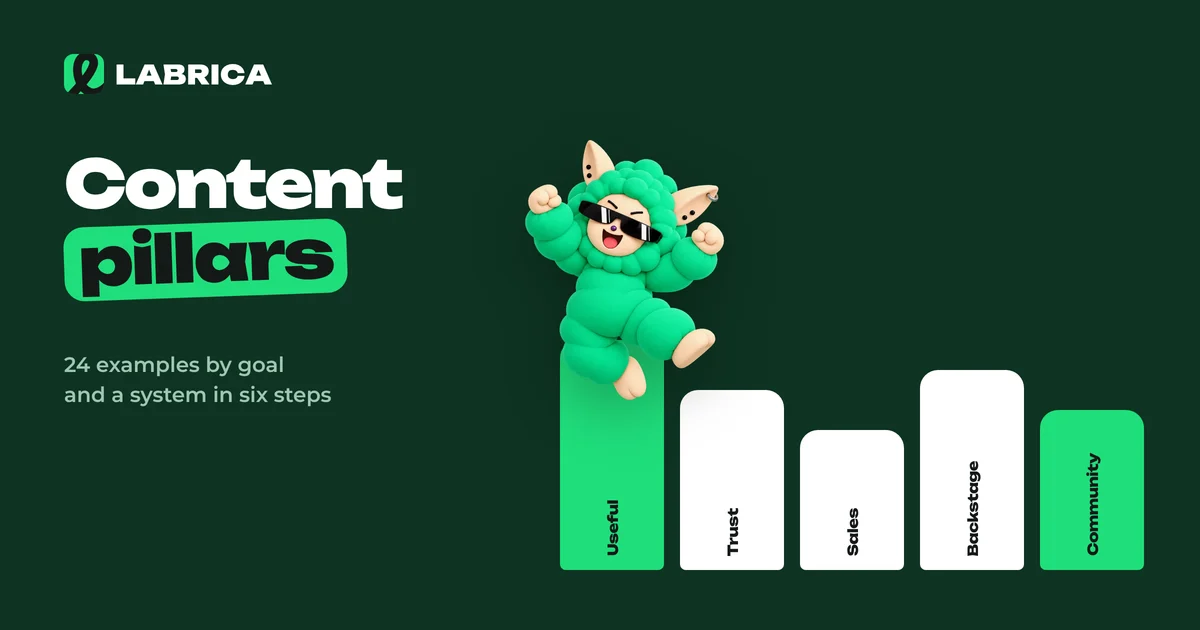
Content pillars are recurring post themes with a clear goal and format, such as "Stylist's tip every Friday". To build them, set your account goals, list your audience's questions and pain points, group them into 4 to 7 pillars, give each one a goal, format and day of the week, and review the results in your analytics once a month.

Content pillars are recurring post themes, each with its own topic, goal and recognizable style. "Monday mistake breakdown", "Friday poll" and "Meet the team" are all content pillars, sometimes also called content categories or recurring post series.
A set of pillars solves three problems at once. You no longer have to invent something to post every day, because you have a framework that topics slot into. Followers get used to the rhythm and look forward to their favorite series. Your content also stays balanced: sales posts don't crowd out useful ones, and entertainment doesn't eat up your expertise.
How a content pillar differs from a topic and a format
For your pillars to work, keep three levels separate.
| Level | What it is | Example for a gym |
|---|---|---|
| Pillar | A permanent "container" with a goal and a recognizable name | "Coach answers" |
| Topic | The specific content of one installment | "Should you train with sore muscles?" |
| Format | How it is delivered | A 30-second short video or a 6-slide carousel |
One pillar can come out in different formats, and one topic can fit into different pillars. If you write "pillar: carousel", that is a mistake. A carousel is packaging, not a pillar.
How to create content pillars in 6 steps
1. Define your account goals
A business on social media usually has 3 or 4 goals: reach new people, build trust, engage followers and sell. Write them down in order of priority. This decides which pillars become your core ones.
2. List your audience's questions and pain points
Collect at least 30 questions customers ask in direct messages, at the checkout, in reviews and in the comments under competitors' posts. For a hair salon, these might be "how long does hair color last", "can I color my hair while pregnant" and "why are you more expensive than a stylist who works from home". This is the raw material for your expert pillars.
3. Look at what has already worked
Open your analytics for the last 3 to 6 months and pick out the 10 best posts by reach and engagement. Future pillars often show up there already: people love stylist stories or before-and-after breakdowns. If you don't have enough history, look at your competitors' best posts. In LABRICA, you can add competitors' social accounts to the analysis and view their posts next to your own.
4. Group topics into 4 to 7 pillars
Combine similar questions and findings. With fewer than four pillars, the feed becomes monotonous. With more than seven, the team can't keep up, the series come out irregularly and lose their purpose.
5. Describe each pillar with a template
Fill in a card for each one:
- Name: short and recognizable, such as "Stylist answers", "Number of the week" or "Behind the scenes".
- Goal: reach, trust, engagement or sales.
- Format: post, carousel, short video, poll, article.
- Frequency and day: for example, every Tuesday.
- Delivery template: how the post opens, what goes inside and how it ends.
- Topic source: where the content comes from, such as customer questions, staff work or industry news.
- Example: one finished post to use as the benchmark.
6. Put your pillars on the calendar and test
Spread the pillars across the days of the week so that two sales posts never sit side by side. After a month, see which pillars get reactions and which fall flat, and replace the weak ones. How to move your pillars into a calendar is covered step by step in how to build a content calendar with AI.
24 content pillar examples by goal
This is an idea bank. Don't take everything. Pick 1 or 2 pillars for each goal.
Content pillars for reach and new followers
| # | Pillar | What's inside | Example |
|---|---|---|---|
| 1 | Quick tip | One hack in 30 seconds, often as a short video | Auto repair shop: "How to check your oil level in a minute" |
| 2 | Myth vs. fact | Busting a popular misconception | Dental clinic: "Myth: whitening destroys enamel" |
| 3 | Roundup | A list of useful things on a topic | Real estate agency: "5 neighborhoods for families with kids" |
| 4 | Trend, our way | A popular format applied to your niche | Bakery: a trending sound over dough-kneading footage |
| 5 | Beginner mistakes | Typical customer slip-ups | Gym: "3 mistakes in your first month of training" |
| 6 | Hot topic take | Commentary on a big industry story | Law firm: "What changed in the rental rules" |
Content pillars for trust and expertise
| # | Pillar | What's inside | Example |
|---|---|---|---|
| 7 | Expert answers | A reply to a real customer question | Salon: "Can you wash your hair right after coloring?" |
| 8 | Case study | Task, solution, result | Renovation company: "How we saved a bathroom after a leak" |
| 9 | Before and after | Visible results of the work | Dry cleaner: a sofa before and after |
| 10 | How we do it | The process step by step | Bakery: "48 hours in the life of a sourdough starter" |
| 11 | Glossary | One term explained | Real estate: "What is an escrow account?" |
| 12 | Review with a comment | A customer review plus the team's reply | Auto repair shop: a review and the mechanic's story of the repair |
Content pillars for engagement
| # | Pillar | What's inside | Example |
|---|---|---|---|
| 13 | Poll of the week | A vote with a clear choice | Coffee shop: "Which syrup should we bring back?" |
| 14 | Guess what | A game that tests product knowledge | Auto repair shop: "Guess the car part from the photo" |
| 15 | Battle | Comparing two options | Salon: "Cool blonde or warm blonde?" |
| 16 | Finish the sentence | An easy reply in the comments | Gym: "After a workout I always…" |
| 17 | Ask the followers | Inviting people to share experience | Bakery: "What do you eat your croissant with?" |
| 18 | Customer creations | UGC: customer photos with the product | Yarn shop: pieces knitted by customers |
Content pillars for sales and loyalty
| # | Pillar | What's inside | Example |
|---|---|---|---|
| 19 | Product of the week | One product or service in detail | Salon: "Hair care after a beach vacation" |
| 20 | Handling objections | Why it is worth the money | Gym: "Why personal training costs more than group classes" |
| 21 | How to order | A step-by-step buying guide | Delivery service: "Place an order in 3 taps" |
| 22 | Limited offer | A promotion with a deadline | Tire shop: "Saturday slots with no waiting line" |
| 23 | Meet the team | Introducing a staff member | Clinic: "Our surgeon on why he chose the profession" |
| 24 | Behind the scenes | Everyday work, preparation, mistakes | Coffee shop: "How we pick a new coffee bean" |
Ready content pillar plans for three businesses
Here is what a weekly grid can look like if you take pillars from the bank and adapt them to a niche.
Bakery (5 posts a week):
- Monday: "How we do it" (a short video about baking).
- Tuesday: "Product of the week" (a new item with its price and baking time).
- Wednesday: "Poll of the week".
- Friday: "Meet the team" or "Behind the scenes".
- Saturday: "Customer creations" with breakfast photos featuring our bread.
Hair salon (4 posts a week):
- Monday: "Before and after" with the stylist's name.
- Wednesday: "Expert answers".
- Friday: "Battle" of shades or haircuts.
- Sunday: "Limited offer" for open booking slots.
Auto repair shop (3 posts a week):
- Tuesday: "Quick tip" (short video).
- Thursday: "Case study" with a photo of the part.
- Saturday: "Guess what" or "Handling objections".
More topics for each category are collected in social media post ideas for business.
How to name a content pillar
A name is more than a formality. A good name tells the reader what to expect and helps the team keep the pillars apart.
- Talk about the benefit, not the format. "One-minute tip" is clearer than "Hack post".
- Add a person. "Stylist Olivia answers" sounds livelier than "Q&A" and builds trust in a specific person right away.
- Tie it to a weekday only if it's true. "Friday battle" works only when the series really comes out on Fridays.
- Stay in your brand voice. A bold barbershop can call its series "Haircuts you won't regret", while a clinic might go with "The doctor explains". How to define your way of speaking is covered in the brand voice guide.
- Check the hashtag. If the pillar has a hashtag, it should be short, unambiguous and not already taken by someone else's content.
How not to kill a content pillar
Pillars die for predictable reasons. Check yours against this list.
- A pillar without a goal. If you can't say why it exists, remove it.
- No source of topics. "Number of the week" without data will run out within a month. Write down 10 future installments right away.
- Production is too complex. A weekly video breakdown with one part-time social media manager is doomed. Match the format to your resources.
- Irregular publishing. A series that comes out once every three weeks stops being a series.
- Same delivery every time. Vary the formats within a pillar: a carousel today, a short video next week.
- No results review. Once a month, compare reach and engagement rate by pillar and honestly close the weak ones.
How to manage content pillars without chaos
Pillars survive as long as they are part of the workflow: topics a month ahead, clear owners, publishing control. In practice, the easiest way is to keep pillars right in the content calendar and tag every post with its pillar name.
In LABRICA it works like this. In the Studio you set the topic and goal of the post (reach, engagement, clicks or sign-ups), and the AI suggests specific ideas for your business, including interactive posts and games, and writes the text in your brand voice. Finished posts go onto the calendar, and analytics shows your best posts, so you can see which pillars are worth growing. The same approach also works with a manual content calendar, it just takes more time.
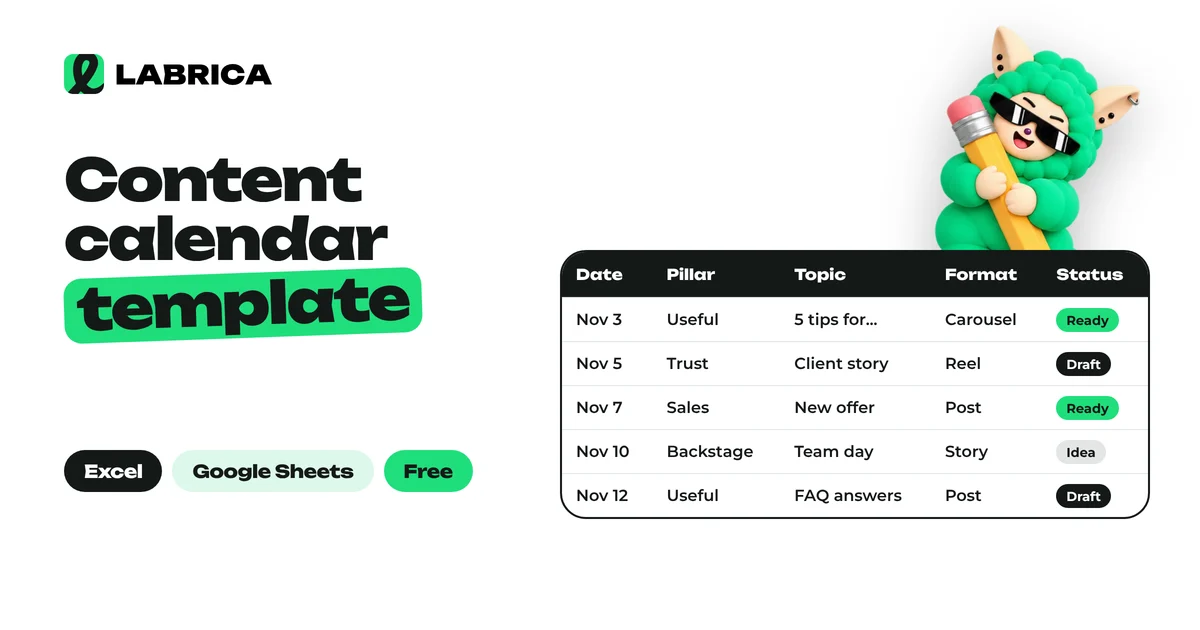
Your pillars are easy to move straight into a spreadsheet. The free social media content calendar template has a dedicated Content pillars sheet and an example month. You can also download the template directly.
Frequently asked questions
How many content pillars should you have?
The sweet spot is 4 to 7. That is enough for variety, and the team can still publish every pillar on a regular schedule.
Should you name your content pillars in the posts?
It is optional, but a recognizable name or a pillar hashtag helps followers look forward to the series and find older installments. For internal work, you always need a name.
How often should you change your content pillars?
Review your pillars every 1 to 3 months based on the numbers. Strong pillars can run for years. Replace weak ones before followers get tired of them.
What is the difference between content pillars and a content calendar?
Content pillars are a set of recurring formats and rules. A content calendar is a specific schedule where every date gets a post from one of the pillars.
Can LABRICA come up with topics for your content pillars?
Yes. In the Studio you can set the topic, goal and tone, and the AI suggests post ideas for your business based on your brand profile, then writes the text and prepares an image or carousel.
Run your social media with LABRICA
Ideas, posts in your brand voice, images, a content calendar and auto-publishing to every network in one window. No card required to start.
- Brand scan of your site and accounts
- Posts and carousels in your brand voice
- Auto-posting to Instagram*, TikTok, X and more
- Analytics and UTM links

Keep reading
 Content planning
Social Media Content Calendar Template: Free Excel and Google Sheets Spreadsheet, Monthly Example and How to Fill It In
A social media content calendar template is a spreadsheet where every post has a date, content pillar, topic, format, platform, goal and status. The minimum version fits in seven columns. Teams add an owner, a UTM-tagged link and results. Below you can download a free Excel template that also opens in Google Sheets, with a sample month and dropdown lists inside.
 Content planning
Social Media Post Ideas for Business: 66 Ideas by Category with Examples
Social media post ideas for business are easiest to find in six categories: educational posts (tips, myths, breakdowns), promotional posts (product, reviews, objections), engagement posts (polls, questions), games and interactive posts, behind the scenes (team, processes) and UGC, content made by customers. Below are 66 specific ideas with short examples for a bakery, a salon, an auto repair shop, a gym and other businesses.
 Content planning
How to Build an AI Content Calendar: A Step-by-Step Guide with a Monthly Template
To build a content calendar with AI, first give it context about the business: audience, products, tone, goals and the month's events. Then ask for content pillars, then post topics for the month with formats and dates, and always edit the result by hand. The quality of the calendar depends on your brief more than on the AI model.