

Social Media KPIs for a Social Media Manager: How to Evaluate the Work and What to Put in the Contract
Social media KPIs for a social media manager work on three levels: process (was the plan delivered on time), content (reach, engagement, saves, clicks) and business (leads and sales from social). Set targets from your own baseline over the last 2 to 3 months, not from benchmarks found online. Follower count and likes should never be the main KPI, because they are easy to inflate without any business value.

"How do we know if our social media manager is doing a good job?" Business owners usually ask this three months after hiring, when the follower count has gone up but leads haven't. Or when leads are coming in, but nobody can tell what social media has to do with it.
The problem is almost always that KPIs weren't agreed on in advance, or the wrong ones were. This guide covers how to choose social media KPIs, set realistic targets for them and write them into a contract so there's nothing to argue about three months later.
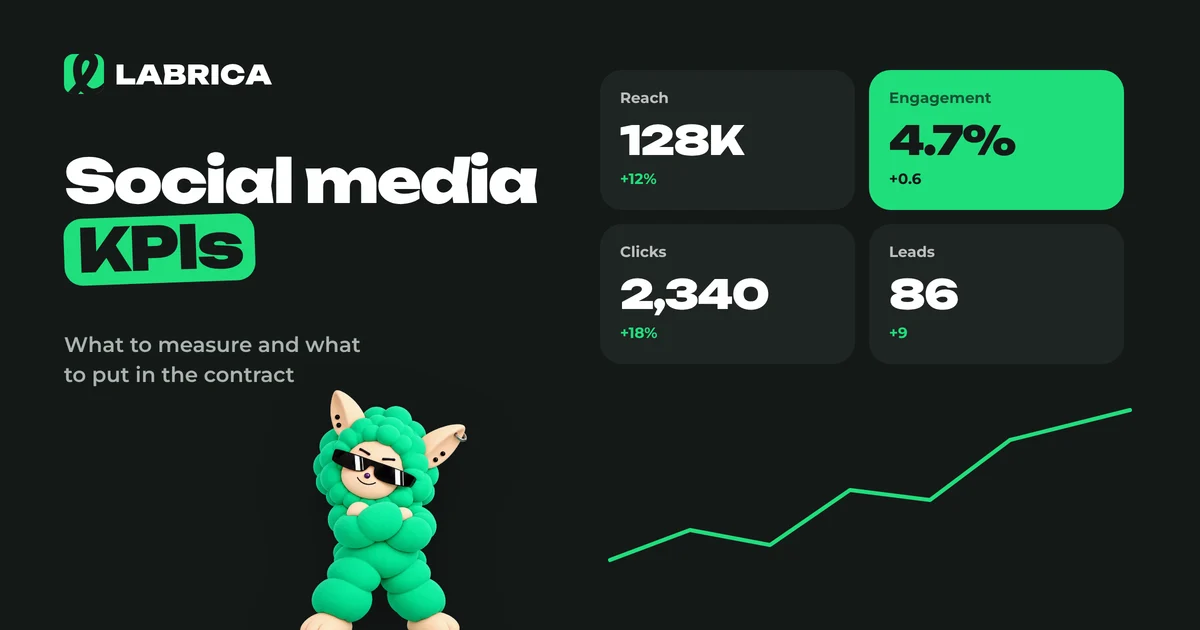
Three levels of social media KPIs
The metrics only work together. Process without content means posting for the sake of posting. Content without business results is a pretty feed that doesn't make money. Business metrics without the other two levels don't tell you what to fix.
| Level | What it shows | KPI examples | Data source |
|---|---|---|---|
| Process | Is the work getting done | Share of posts published as planned; approval deadlines met; response time to messages | Content calendar, inbox |
| Content | Is the content working | Reach as a % of followers, engagement rate, saves and shares, link clicks, unfollows after posts | Platform analytics, UTM links |
| Business | Is it bringing in money | Leads from social, cost per lead including ads, sales, share of customers who came from social | CRM, UTM parameters, "how did you hear about us" |
How to calculate the main content metric and why it varies so much is covered in the guide to engagement rate. That guide is about measuring content. This one is about evaluating a person or an agency.
KPIs you shouldn't set
Follower count as the main goal. Followers can be bought, pulled in through a giveaway or brought over from an off-target promotion. The number will grow while reach as a percentage and leads will drop.
Likes and views on their own. They are a signal, not a result. A cat photo will get more reactions than a breakdown of your service, but the second one sells.
Metrics the manager can't influence. If your prices are above market and your sales team calls leads back three days later, "sales from social" is an unfair KPI for one social media manager. Assign it to the team instead.
Too many KPIs. Nobody can keep fifteen metrics in mind. Pick 3 to 5.
Should you pay a social media manager per follower?
No. It directly rewards buying followers and attracting anyone at all. If you need a growth metric, use "follower growth while keeping reach as a percentage at or above baseline," or cost per retained follower from paid campaigns.
Social media KPIs by business goal
| Goal | Primary KPIs | Supporting KPIs |
|---|---|---|
| Sales and leads | Leads from social, click-to-lead conversion rate | Link clicks, direct messages |
| Awareness | Reach, growth of the target audience, mentions | Shares, reach as a % of followers |
| Loyalty of existing customers | Repeat purchases by followers, engagement rate, reviews | Replies to comments, response time |
| Hiring | Job applications from social | Reach of posts about the team |
| Thought leadership (B2B) | Leads, mentions in deals, posts used by the sales team | Saves, follows from target companies |
In B2B, where a deal can take months to close, social media rarely gets the last click. Agree in advance on how the sales team records the role of social content in a deal, otherwise the business level will always look empty.
If your KPIs need to answer "does social media pay off," add ROMI, customer acquisition cost and lifetime value to the business level and agree on how sales are attributed to social.
How to set targets without "numbers from the internet"
Benchmarks like "a good engagement rate is 3% and up" don't mean much. The number depends on the platform, the niche, the account size and the calculation method.
It is more reliable to start from your own data:
- Build a baseline for the last 2 to 3 months: median reach, engagement rate, clicks, leads.
- If there's no data (a new account), set only process KPIs for the first two months and record the content metrics as your baseline.
- Set growth targets relative to the baseline instead of absolute numbers: "median post reach +20% over baseline this quarter."
- Review targets quarterly. If a target was hit easily, raise it. If it can't be reached without budget, discuss the budget.
KPIs for "one person plus AI"
When a social media manager works with AI and automation tools, the job itself changes: less time goes into writing and posting, more into ideas, facts, review and talking to customers. It makes sense to add metrics that reflect this:
- Share of posts published on schedule, with no gaps or reschedules.
- Time from idea to publication: how many days pass between a topic appearing and the post going live.
- Approval time: how long a post waits for "approved."
- Share of posts accepted without major edits, a measure of draft quality.
- Number of new formats or tests per month. The time saved should go into experiments.
In LABRICA, part of this data is visible without manual counting: the content calendar shows what was planned and what went out, statuses show where a post is stuck in approval, and platform analytics plus short links with UTM tags provide the content metrics and some of the business ones. See the LABRICA home page for details.
Example social media KPIs for a contract or brief
Wording you can use as a starting point and adapt:
1. The Contractor publishes at least 12 posts per month on the Telegram channel and the Instagram* account according to the approved content calendar. KPI: at least 90% of posts are published on the planned day.
2. The Contractor submits the content calendar for the following month no later than the 25th of the current month.
3. Response time to direct messages during business hours (10:00 a.m. to 7:00 p.m.) is no more than 2 hours.
4. Content KPI: median post reach for the quarter is no lower than the baseline value [X], recorded after the first two months of work.
5. Clicks to the website from links with UTM parameters: at least [Y] per month. Data source: the Client's Google Analytics 4 property.
6. A KPI report is delivered by the 5th of the following month using the form in Appendix N.
Notice that each item names the data source and the calculation method. Without that, any KPI turns into an argument about whose stats are right. To track clicks and leads, you need UTM parameters on every link.
If a KPI is tied to a bonus, specify what happens in case of force majeure: a platform blocking the account, the client pausing ads, a price change.
If the social media manager owns the publishing calendar, you can include preparation for seasonal dates and holidays in the process KPIs. The guide to building an AI content calendar shows how to plan them.
Social media report template
| Metric | Target | Actual | Baseline | Comment |
|---|---|---|---|---|
| Posts published as planned | 12 | 11 | Not set | One moved because of a price approval |
| Median post reach | ≥ 1,800 | 2,050 | 1,800 | How-to breakdowns performed best |
| Engagement rate | Not set | Not set | Not set | Tracking only |
| Clicks to website | ≥ 150 | 132 | 120 | Few links in posts in the second half of the month |
| Leads from social | Not set | 14 | 11 | From the CRM, source "social" |
| Response time to messages | ≤ 2 h | 1.5 h | Not set |
The numbers in the template are examples. The most important parts of the report are the Comment column and the section that follows: what you'll do next month based on the numbers. A report without conclusions is just a table.
*Instagram, Facebook and Threads belong to Meta Platforms Inc., which is designated an extremist organization in the Russian Federation.
Frequently asked questions
What KPIs should a social media manager have?
Choose 3 to 5 metrics across three levels: process (posts published as planned, deadlines, response time), content (reach as a percentage, engagement rate, clicks) and business (leads from social). The exact set depends on the goal: sales, awareness, hiring or loyalty.
How do you evaluate a social media manager when there's no data yet?
For the first two months, evaluate the process: plan delivery, deadlines, quality of replies to customers. Content metrics from that period become the baseline for next quarter's targets.
Can you tie a social media manager's pay to follower count?
It's not a good idea, because it rewards buying followers and attracting the wrong audience. If growth matters, use follower growth while keeping reach as a percentage at baseline, or cost per retained follower.
How do you write social media KPIs into a contract?
For each metric, state the target value, the period, the data source and the calculation method, plus the report format and deadline. List the circumstances that don't count, such as a platform blocking the account.
Where can I see KPI data in LABRICA?
In LABRICA, the content calendar shows what was planned and what was published, statuses show which posts are waiting for approval, and platform analytics plus short links with UTM tags show views, reactions, engagement rate and clicks for each post.
Run your social media with LABRICA
Ideas, posts in your brand voice, images, a content calendar and auto-publishing to every network in one window. No card required to start.
- Brand scan of your site and accounts
- Posts and carousels in your brand voice
- Auto-posting to Instagram*, TikTok, X and more
- Analytics and UTM links

Keep reading
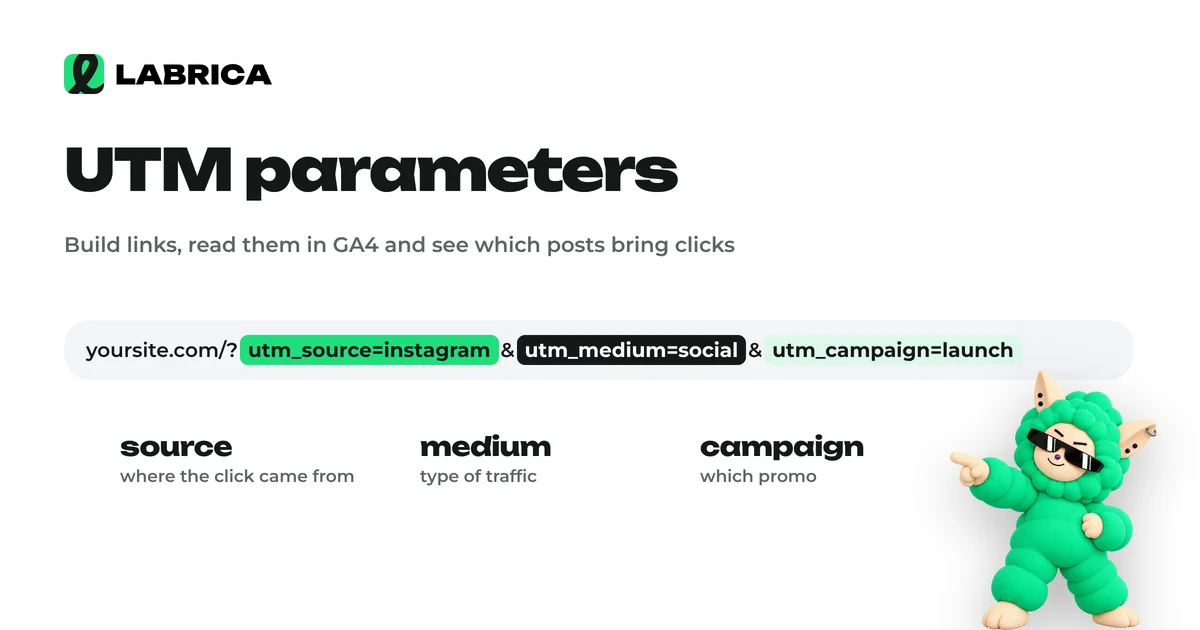 Analytics
UTM Parameters for Social Media: How to Build Them, Link Examples and Naming Conventions
UTM parameters are tags added to the end of a link that tell your web analytics, such as Google Analytics 4, which social network, campaign and post a visitor came from. For social media you need three required parameters, utm_source, utm_medium and utm_campaign, and utm_content helps you tell individual posts apart. Consistent naming conventions matter most, or your reports turn into chaos.
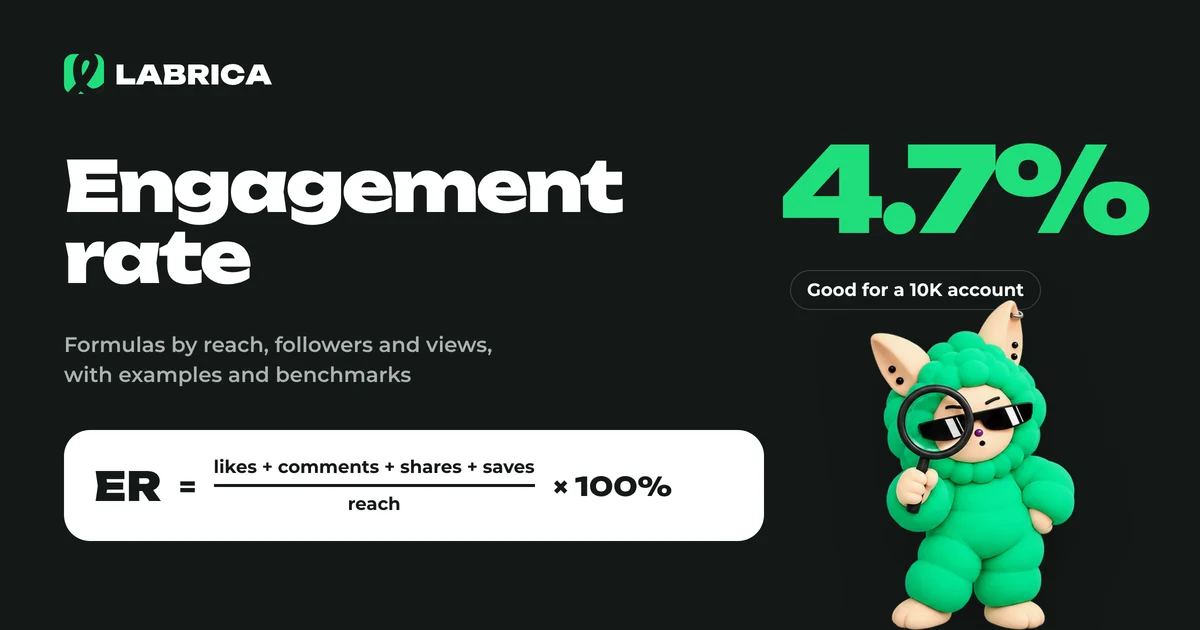 Analytics
What Is Engagement Rate and How to Calculate It: Engagement Rate Formulas with Examples
Engagement rate (ER) shows what share of your audience interacted with a piece of content. It's calculated as the sum of reactions, comments, shares and saves divided by reach, followers or views, multiplied by 100%. The result depends on which base you choose, so pick one formula and stick with it.
 Content planning
How to Build an AI Content Calendar: A Step-by-Step Guide with a Monthly Template
To build a content calendar with AI, first give it context about the business: audience, products, tone, goals and the month's events. Then ask for content pillars, then post topics for the month with formats and dates, and always edit the result by hand. The quality of the calendar depends on your brief more than on the AI model.