

Social Listening: What It Is, How It Differs from Social Media Monitoring and How to Use It in Marketing
Social listening is the analysis of what people say about your brand, your competitors and your category on social media, forums and review sites. Social media monitoring answers where and how often you were mentioned. Social listening goes further and answers what follows from it. Its insights turn into content ideas, product fixes and answers to common objections.

People talk about companies all the time: in comments, group chats, map reviews and forums. Most of these conversations never reach the brand. Social listening is a way to hear them and draw conclusions: what people like, what annoys them, what they ask about and what they praise in your competitors.
For marketing, it is one of the cheapest sources of ideas. Customers spell out what matters to them, in their own words.
Social listening vs. social media monitoring: the difference
The two terms are often confused, even though they do different jobs.
| Social media monitoring | Social listening | |
|---|---|---|
| Question | Where and when were we mentioned? | What do people think, and why? |
| Time frame | Here and now | Trends over months |
| Action | Reply to a specific review or complaint | Change your content, product or positioning |
| Example | A customer complained in the comments and got a reply within an hour | One in five reviews mentions slow delivery, so the company fixed its logistics and posted about the change |
Monitoring is a reaction, and listening is a strategy. You need both. Without monitoring you miss complaints, and without listening you don't see the patterns.
What to track in social listening
- Brand mentions. Your name, its spelling variants, common typos, and the names of your founders and products.
- Competitors. What people say about them, and what they praise and criticize them for.
- Your category. General questions and problems, such as "where can I get a manicure without waiting" or "which mattress is best for back pain".
- Sentiment. Positive, negative and neutral questions.
- Frequent questions and objections. What people ask before they buy.
- The words customers use. Reuse them later in your posts and ads.
Where to listen
- Comments and messages on your own social accounts. The most obvious source, and the most underrated one.
- Reviews on Google Maps and marketplaces. This is where customers write in the most detail.
- Chats and communities in your niche. Neighborhood groups, professional communities, forums, Reddit threads.
- Competitors' social accounts. Comments under their posts show what their customers are missing.
- Search suggestions and queries. What people search for together with your brand name.
- AI assistant answers. More and more people ask ChatGPT, Gemini and Perplexity about companies, so it is worth knowing what those assistants say. The guide to generative engine optimization explains how to influence that.
Sentiment analysis of mentions
Sentiment is the emotional tone of a mention: positive, negative or neutral. Monitoring tools detect it automatically, but they often get sarcasm and slang wrong, so double-check important mentions by hand.
The overall share of negative mentions tells you less than the reasons behind them. A simple table helps you see the picture:
| Topic | Positive | Negative | What to do |
|---|---|---|---|
| Quality | Often praised | Rarely | Show it in your content and collect reviews |
| Delivery | Neutral | Frequent complaints about delays | Fix the process and tell people about the changes |
| Price | Few mentions | Occasional "too expensive" | Explain the value in your posts |
| Service | A specific manager gets praise | Complaints about slow replies | Feature that manager in your content and set up faster replies |
How to turn social listening insights into content
Social listening pays off when its insights reach your content calendar. A few examples:
- A frequent question becomes an answer post or a carousel. If people keep asking "how long does gel polish last", you need a post about exactly that.
- A frequent objection becomes a breakdown with arguments. If people say "too expensive", write a post about what goes into the price.
- Customer wording becomes your headlines. If customers say "so it doesn't dry out my skin" and you write "for moisture retention", use their phrasing.
- Praise becomes a review post, with the author's permission.
- A competitor's weak spot becomes your advantage, if you really have it.
To turn these insights into finished posts quickly, use the templates in ChatGPT prompts for social media and spread them across your content pillars.
How to run social listening on a small budget
You can start without any special tools:
- Set aside an hour once a week. Read comments, messages, map reviews and the comments under competitors' posts.
- Log everything in a spreadsheet: source, topic, sentiment, quote.
- Once a month, look at which topics keep coming up.
- Turn the three most frequent topics into content or product changes.
Once mentions reach hundreds a week, manual review can no longer keep up. At that point you need a monitoring tool that collects mentions by keyword and scores their sentiment.
What LABRICA can and can't do here
LABRICA doesn't offer social listening in the full sense, meaning it doesn't collect mentions across all social networks and forums. It does have tools that sit next to this task:
- Competitor analysis. LABRICA studies your competitors' social accounts: what they post about, which formats they use and what performs well for them.
- Analytics for your own accounts. Followers, views, reactions, engagement rate and best posts by platform. For the metrics themselves, see what engagement rate is and how to calculate it and social media KPIs.
- From insight to post. Insights from listening are easy to turn into posts right away: the Studio writes them in your brand voice, and the content calendar publishes them on schedule.
Frequently asked questions
What is social listening?
Social listening is the analysis of conversations about your brand, competitors and category on social media, review sites and forums. The goal is to understand what people think and use those insights in marketing and product decisions.
What is the difference between social listening and social media monitoring?
Monitoring tracks mentions and helps you reply quickly. Listening analyzes mentions over a longer period and looks for patterns: recurring topics, reasons for dissatisfaction and frequent questions.
What is sentiment analysis on social media?
It is an assessment of the tone of mentions: positive, negative or neutral. Automated tools make mistakes with sarcasm and slang, so important mentions are checked by hand.
Can you do social listening for free?
Yes, at the start you can do it by hand. Once a week, read comments, reviews and competitors' accounts and log the topics in a spreadsheet. Paid tools become necessary when there are too many mentions to read.
Does LABRICA have brand mention monitoring?
LABRICA doesn't have full social media monitoring. It offers competitor analysis of social accounts and analytics for your own posts.
Run your social media with LABRICA
Ideas, posts in your brand voice, images, a content calendar and auto-publishing to every network in one window. No card required to start.
- Brand scan of your site and accounts
- Posts and carousels in your brand voice
- Auto-posting to Instagram*, TikTok, X and more
- Analytics and UTM links

Keep reading
 Analytics
Social Media KPIs for a Social Media Manager: How to Evaluate the Work and What to Put in the Contract
Social media KPIs for a social media manager work on three levels: process (was the plan delivered on time), content (reach, engagement, saves, clicks) and business (leads and sales from social). Set targets from your own baseline over the last 2 to 3 months, not from benchmarks found online. Follower count and likes should never be the main KPI, because they are easy to inflate without any business value.
 Analytics
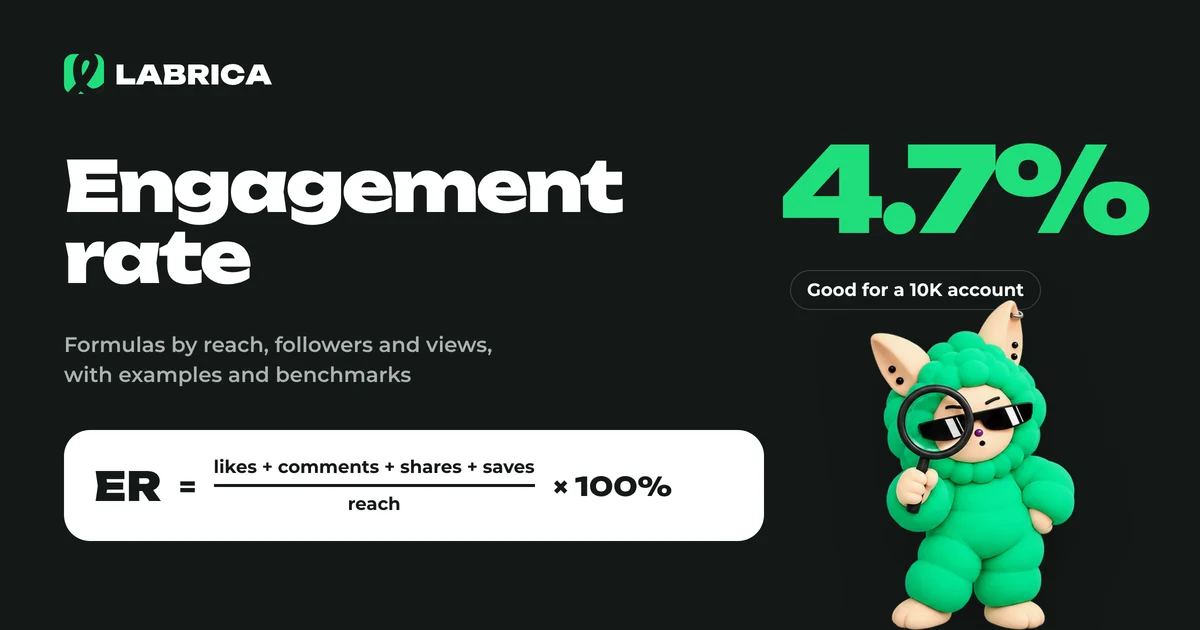
What Is Engagement Rate and How to Calculate It: Engagement Rate Formulas with Examples
Engagement rate (ER) shows what share of your audience interacted with a piece of content. It's calculated as the sum of reactions, comments, shares and saves divided by reach, followers or views, multiplied by 100%. The result depends on which base you choose, so pick one formula and stick with it.
 AI for social media
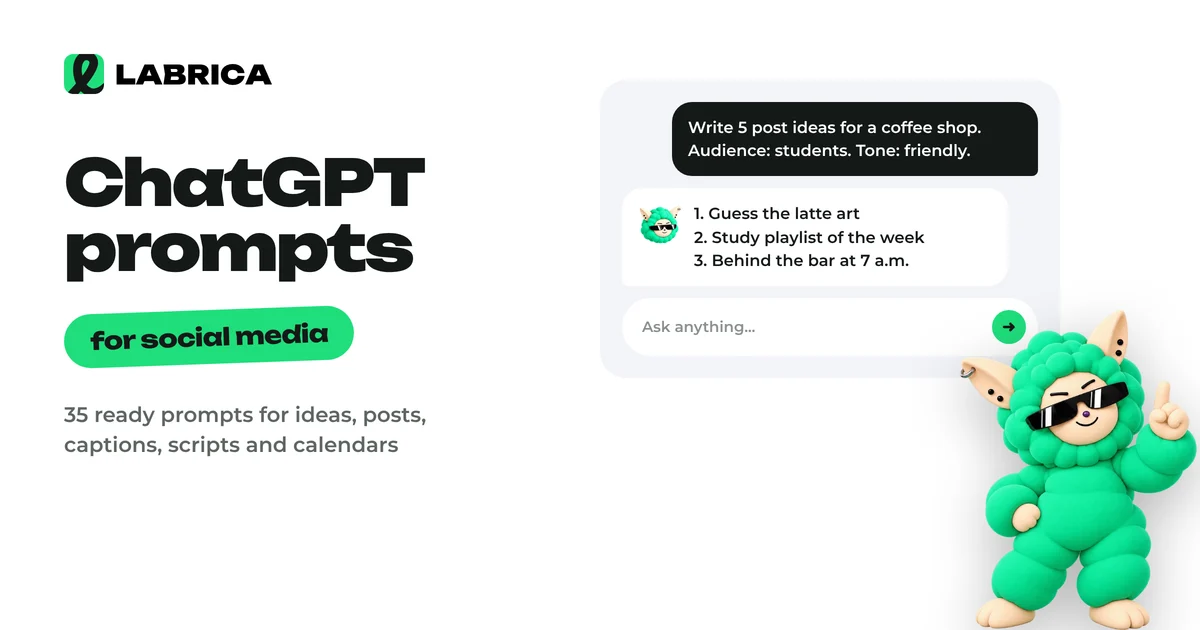
ChatGPT Prompts for Social Media: 35 Ready-to-Use Prompts by Task
A good ChatGPT prompt for social media has five parts, which are role, brand context, task, format and constraints. Below are 35 ready-to-use prompts grouped by task, with placeholders in square brackets. Fill in your business details and you get a draft that needs editing instead of a full rewrite.