

Personal Branding on Social Media: A Step-by-Step Guide for Experts and Consultants
To build a personal brand on social media, state who you help and with what, pick one main platform, and publish 3 to 4 posts a week across three lines of content: expertise, personality and client results. A personal brand grows from a recognizable position you repeat consistently in every post, much more than from posting volume or reach.

A personal brand on social media is what people think of you before they've ever worked with you, based only on your posts. For an expert, that's the main source of trust. A client arrives already feeling they know you and pushes back less on price.
When experts struggle with personal branding on social media, the problem is rarely a lack of knowledge. It's usually three barriers: not knowing what to write about, feeling awkward about showing yourself, and not having time. A system removes all three. This guide goes from positioning to a 30-day plan, with post examples for different professions.

How a personal brand differs from a company account
| Company account | Expert's personal brand | |
|---|---|---|
| Who speaks | The brand, "we" | A specific person, "I" |
| Why people follow | Product, promotions, usefulness | The person, their views, experience, style |
| Main asset | Product range, service | Position and trust |
| Tone | A consistent brand voice | Personal, with opinions and stories |
| Risks | Facelessness | Dependence on one person, burnout |
An expert can, and should, say things a company won't: a personal opinion, a debatable take, a story about a mistake. That's exactly what makes a personal brand stronger than a corporate account.
Step 1. Define your positioning
Positioning answers the question "why you?" Build it with this formula:
I help [who] [solve what problem] [through what / how].
Examples:
- Lawyer: "I help small business owners avoid losing money on commercial leases by reviewing the risks before they sign."
- Fitness coach: "I help office workers over 40 get back into exercise without injuries, with short workouts at home and at the gym."
- Real estate agent: "I help families buy their first new-build home and choose a reliable developer."
- Esthetician: "I help people take care of their skin without unnecessary treatments by explaining what they actually need."
A narrow statement feels scary at first, as if you're turning clients away. In practice, people remember you faster when you can be described in one sentence. You can broaden it later.
Step 2. Choose one main platform
If you're short on time, run one platform well rather than three badly. Use the others to adapt your best material.
- Telegram suits experts who like to write and reason: lawyers, financial advisors, marketers, consultants.
- Instagram* and Threads work for visual niches and people who are comfortable on camera: estheticians, trainers, designers, photographers.
- Facebook fits local specialists whose audience looks for services inside groups and communities.
- YouTube and short video are for people who talk easily on camera and are willing to invest in filming.
- LinkedIn is a natural home for B2B consultants and professionals who sell to companies.
The test is simple: where does your client already look for solutions, and which format can you comfortably produce every week?
Step 3. Set three lines of content
An expert's social media rests on a balance of three lines. Lean too hard on one and the brand weakens.
- Expertise. Breakdowns, tips, answers to questions, common mistakes, myths. Shows you know your craft.
- Personality. Your views, working principles, stories from life and work, behind the scenes. Explains why you're pleasant to work with.
- Results. Client cases (with their consent and without sensitive details), testimonials, before and after, how the work goes. Proves the method works.
A practical guideline: roughly equal parts expertise and personality, plus regular results. Sales posts are woven into these lines instead of running as a separate stream.
Step 4. Create content pillars
Content pillars take away the daily question "what do I post today?" Pick 5 or 6 and repeat them every week.
| Pillar | Line | Example for a lawyer | Example for a coach |
|---|---|---|---|
| Case breakdown | Expertise | "The tenant moved out and the deposit wasn't returned. What now?" | "Why your knee hurts after squats" |
| Myth vs fact | Expertise | "A verbal agreement isn't binding. True?" | "Should you drink water during a workout?" |
| Q&A | Expertise | A question from the comments | A question from DMs |
| My take | Personality | "Why I don't take every case" | "Why I'm against 'lose 20 pounds in a month' challenges" |
| Life and work | Personality | How the week went, what I'm reading | How I train myself |
| Client story | Results | How a dispute was settled out of court | How a client got back to running |
For a deeper walkthrough of building a set of pillars, see the guide to content pillars. If you need more topics per category, there's a list of social media post ideas.
Step 5. Write posts people actually read
A few rules that change the quality of expert posts the most:
- Start with the reader's situation, not with yourself. Skip "Today I'll talk about…" and open with "You signed the lease, and a month later you found out…".
- One idea per post. If there are two topics, that's two posts.
- Be specific. "Check the early termination clause" beats "read your contract carefully."
- Use plain language. Explain any professional term.
- Have an opinion. A post people can argue with gets more comments than a neutral summary.
- End with an action. A question for the reader, a suggestion to save the post, an invitation to book a call.
Example post for a real estate agent
"The developer promises the building will be ready in a year. How do you check that's more than words?
I always look at three things. First, how many buildings this developer has already delivered and whether any were delayed. Second, the building permit and the project documents: they list deadlines you can compare with the promise in the ads. Third, how construction is going right now. If the site is empty and the deadline is six months away, the questions ask themselves.
It's not a guarantee, but it filters out most of the risk. If you're choosing a new-build and have doubts, send me the project name in a DM and I'll tell you what to look at."
The post has the reader's situation, personal experience, concrete steps and a soft call to action. More ways to end a post are in the guide to social media captions.
Step 6. Solve the time problem
The main reason experts abandon social media is lack of time. Three techniques help.
- Batching. One or two hours once a week to prepare all of next week's posts.
- A topic bank. Write down client questions, tricky situations and ideas the moment they come up. Within a month you'll have more topics than you can write.
- AI as an assistant. An AI tool turns your notes and voice memos into a draft, suggests ideas by pillar, and makes carousels and cover images. You edit and add the personal part.
LABRICA works well for the third technique. Its brand scan studies your website and existing posts and builds a brand profile: audience, services, tone and rules. You can refine how you address readers, which phrases you never use and which topics are a must. After that, LABI AI writes drafts in your voice instead of generic language. The guide to brand voice explains how to describe your tone so AI follows it.
Tip: even with AI, keep at least one detail in every post that only you know: a case from your practice, your opinion, a real phrase from a client. That detail is what makes the post personal.
If you sell courses or run an online school, the same approach covers warm-up content before a launch and posts between cohorts.
Step 7. Post consistently and watch the numbers
For a personal brand, consistency matters more than the perfect text. Aim for 3 to 4 posts a week on your main platform, plus adapted versions of the best ones elsewhere. The guide on how often to post on social media goes deeper on frequency and timing.
Schedule posts in advance so a busy week doesn't break the rhythm. In LABRICA, posts go into the content calendar and publish automatically to several social networks at once, and analytics shows best posts and engagement for each platform. Short links with UTM tags show which posts bring people to a consultation.
Once a week, answer three questions: which posts got the most reactions and saves, which ones led to inquiries, and which topic is worth developing. What engagement is and how to calculate it is covered in the guide to engagement rate.
How to set up an expert profile
Your profile is the shop window a new reader scans in a few seconds. If it doesn't show who you are and how you help, even your best posts won't save it.
- Photo. Face close up, good light, neutral background. No group shots and no logo in place of your face.
- Name and title. Name plus profession or niche: "Anna, commercial lease lawyer for small businesses." This also helps search inside the platform.
- Bio. Your positioning statement, one line of credibility (experience, specialization) and one action: "DM me" or "book via the link."
- Pinned post. Who you are, what you work on, where to start reading, how to book. Update it every few months.
- Link. One main link with a UTM tag so you can see clicks from the profile.
For bio wording and examples, see the guide to the social media bio.
Profile checklist
- In 5 seconds, the bio makes clear who you help
- The photo is recognizable even as a small circle
- There's one clear action
- An introduction post is pinned
- Your last 6 to 9 posts reflect your pillars, not random topics
How to talk about your services without fear of selling
Many experts run a useful blog for years and wonder why clients don't come. Usually readers simply don't know how to work with them.
- Mention your work in expert posts. "In a consultation last week we went over a similar contract" is already a reminder that you consult.
- Once every week or two, publish a direct post about a service. Who it's for, what problem it solves, how it works, how to book.
- Show the process. What the first meeting looks like and what the client gets at the end.
- Answer objections. "Too expensive," "I'll handle it myself," "not now": each one can be its own post.
- Offer an easy first step. A short assessment, a checklist, a quick review in DMs.
The guide on how to write a sales post has structures for that direct service post.
Your first 30 days
Week 1. Define your positioning and set up your profile: photo, bio with the "I help who with what" formula, a pinned post about you. Build a bank of 20 topics.
Week 2. Launch your pillars: 3 to 4 posts, at least one expertise post, one personal post and one with a question for the audience.
Week 3. Add a carousel or a short video. Publish your first client case or a breakdown of a situation from your practice.
Week 4. Review your analytics, keep the pillars that work and replace the weak ones. Publish your first soft sales post: an invitation to a consultation or a service.
Common personal branding mistakes
- Writing for peers instead of clients. Jargon and professional debates don't interest the people who pay.
- Only value, no personality. The result is a reference book, not a person people want to work with.
- Only personal, no expertise. The audience grows but doesn't know what to come to you for.
- Waiting for inspiration. Without pillars and a plan, posting happens in bursts.
- Being afraid to sell. If you never mention your services, people won't know you take clients.
- Copying someone else's style. A personal brand is built on what makes you different.
*Instagram, Facebook and Threads belong to Meta Platforms Inc., which is designated an extremist organization in the Russian Federation.
Frequently asked questions
How do I start a personal brand on social media with zero followers?
Start with positioning and your profile, then post regularly by pillar. Your first readers usually come from existing clients, colleagues and acquaintances you tell about the launch.
How many times a week should an expert post?
Aim for 3 to 4 posts a week on your main platform. Consistency matters more: three posts every week beats seven in one week followed by a month of silence.
Do I need to share my personal life?
No. It's enough to show yourself at work, your principles, your views and stories from your profession. You decide where the line is.
Can I build a personal brand with AI?
Yes, if you use AI for drafts, ideas and visuals and add your own experience and opinion to the final text. Fully generated posts without personal details usually sound faceless.
Does LABRICA work for a personal brand, not just a company?
Yes. The brand scan and brand profile can be set up for you as an expert, with your audience, services and communication style, and then you use post generation, the content calendar and analytics the same way a business does. You can try it free.
Run your social media with LABRICA
Ideas, posts in your brand voice, images, a content calendar and auto-publishing to every network in one window. No card required to start.
- Brand scan of your site and accounts
- Posts and carousels in your brand voice
- Auto-posting to Instagram*, TikTok, X and more
- Analytics and UTM links

Keep reading
 Strategy
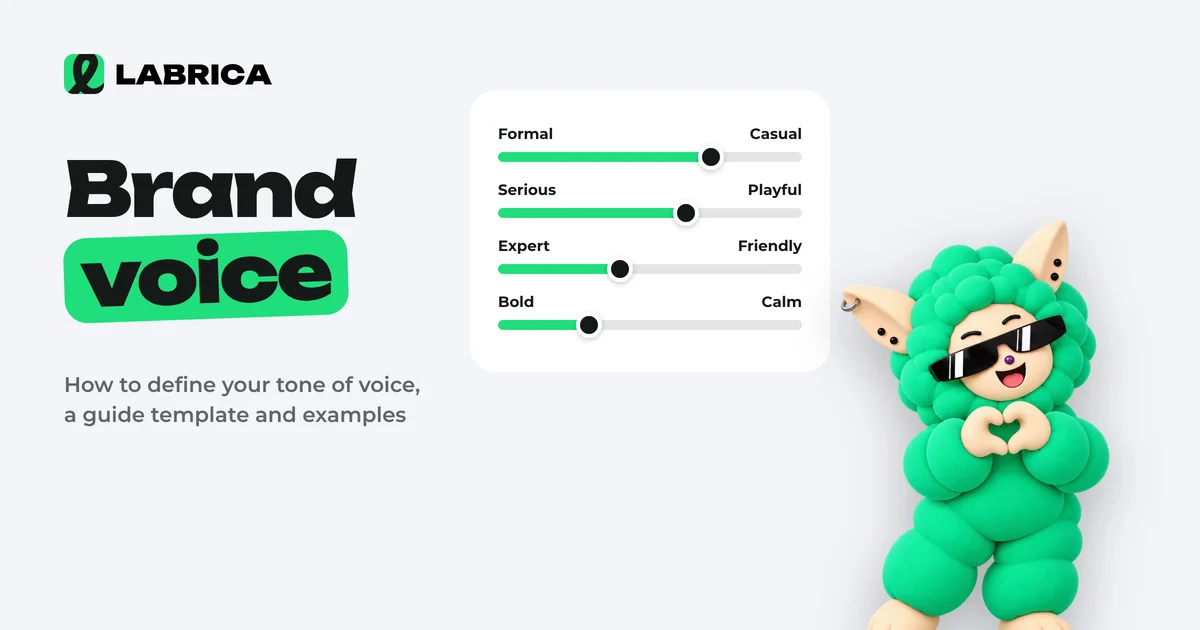
Brand Voice: How to Define Your Company's Tone of Voice, a Guide Template and Examples
Brand voice is the consistent set of rules a company follows when it talks to its audience: how formal it sounds, how serious, which words it uses and with what emotion. To define it, describe your audience and values, pick a position on four tone scales, list the words you use and avoid, and put it all into a short guide with examples.
 Content creation
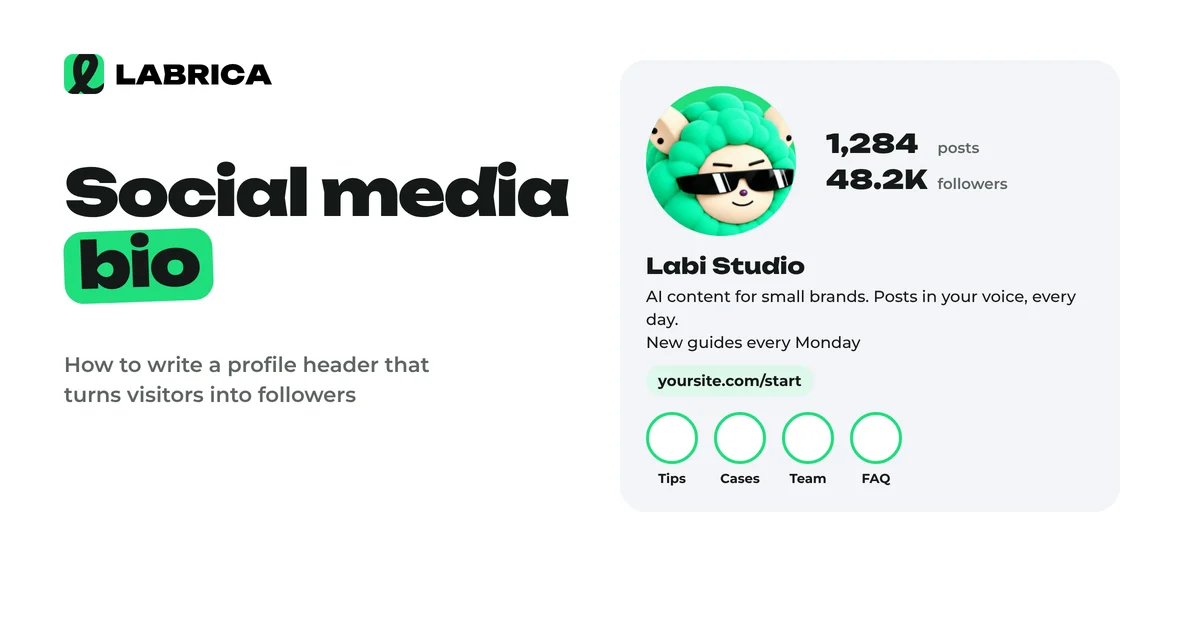
How to Write a Social Media Bio: Formula, Profile Setup Tips and 30 Bio Examples for Business
A social media bio has a few seconds to answer three questions for a new visitor. Who you are, how you help them specifically and what to do next. A reliable bio formula is what you do and for whom, then a differentiator or proof, then a call to action with a link or contact. Add a keyword people search for to your profile name.
 Content creation
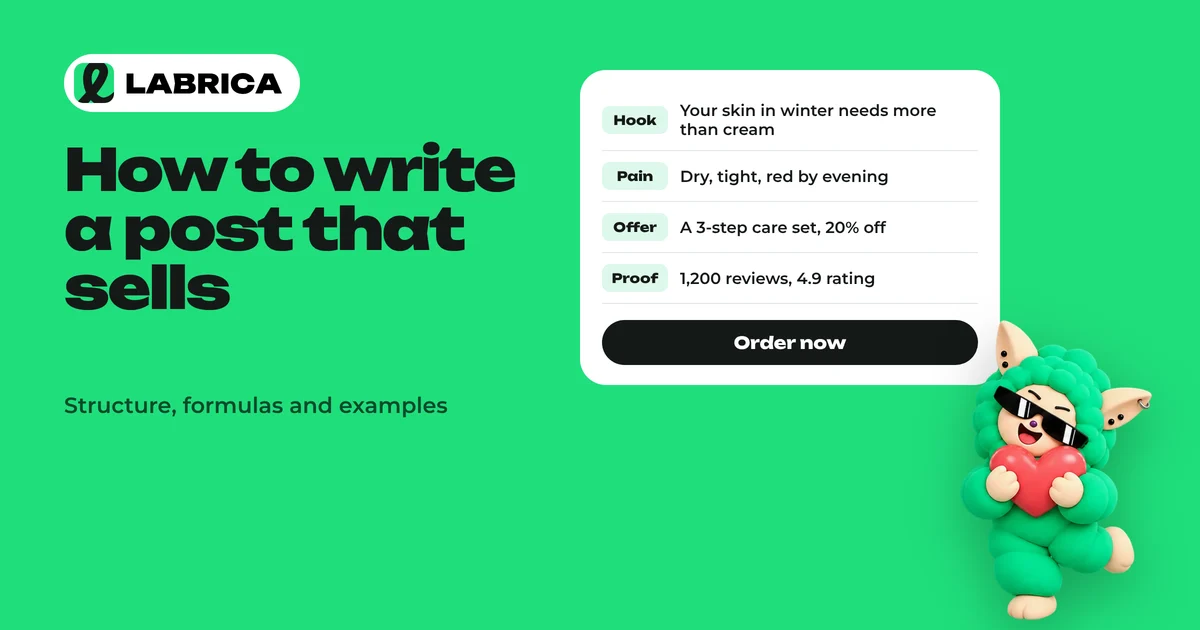
How to Write a Sales Post for Social Media: Structure, AIDA and PAS Formulas, Examples
A sales post is built around one reader situation and one action you want the reader to take. Before writing, answer four questions: who it's for, what situation they're in, what you're offering and what they should do. Then pick a formula (AIDA for a new product, PAS for a clear pain point, BAB for a visible result) and finish with a specific call to action and a reason to act now.